 Listicle
Safe Cat Dental Care Products: What Actually Works
Last Updated: November 12, 2026
Quick Summary
Safe cat dental care products in Canada are those with a clear safety record, feline-appropriate ingredients, and evidence they reduce plaque or tartar, such as the VOHC Seal of Acceptance. Avoid human toothpaste, fluoride, xylitol and unnamed natural ingredients, and confirm suitability with your vet before use.
- The VOHC Seal of Acceptance marks products meeting standards for reducing plaque or tartar.
- A 2025 FelineVMA guideline recommends only safe and effective dental products for cats.
- In a 2021 study, tooth brushing was the most reported dental-care action at 80%.
- Dental treats were reported by just 23% of owners, and dental food by 21%.
- A water additive only works if your cat actually drinks the treated water.
Table of Contents
- What Makes a Cat Dental Product Safe
- Safe Toothpaste for Cats: What to Look For
- How to Brush a Cat's Teeth Without a Fight
- Dental Treats for Cats: Evidence Versus Marketing
- Cat Dental Water Additive and Other Low-Effort Options
- Comparing the Options: Cost, Effort and Evidence
- When Home Care Is Not Enough
- Building Your Cat's Dental Routine with Bentley's Bark
- Frequently Asked Questions
What Makes a Cat Dental Product Safe
Safe cat dental care products in Canada are those with a clear safety record, ingredients appropriate for feline use, and evidence that they actually reduce plaque or tartar. The Veterinary Oral Health Council runs a widely recognized verification program for pet dental products.
That matters because the feline dental care market is crowded and loosely regulated. Products arrive as treats, additives, sprays, gels, foams and powders, and many make bold claims with little behind them.
Ingredient Red Flags and the VOHC Seal
The VOHC Seal of Acceptance is a voluntary mark awarded to products that meet the council's standards for reducing plaque or tartar. The VOHC accepted products list includes a dedicated category for cat dental diets, which tells you the program treats felines as their own case rather than an afterthought to dogs.
Watch for these red flags:
- Human toothpaste. Fluoride and xylitol are not meant to be swallowed by cats.
- Unnamed "natural" ingredients. A label that will not list what is inside cannot be assessed.
- Treats with no dental claim. A chewy snack is not a dental product.
A 2025 feline oral-health guideline from the FelineVMA recommends only safe and effective products, which is a polite way of saying most of what is on the shelf does not qualify. FelineVMA oral health guidelines
Safe Toothpaste for Cats: What to Look For
Safe toothpaste for cats is a pet-specific gel or paste with a short, disclosed ingredient list and no fluoride or xylitol. Flavor matters more than most owners expect, because a cat that rejects the taste will reject the whole routine.
Look for enzymatic formulas, which use enzymes to help break down plaque rather than relying on abrasive scrubbing. Avoid artificial flavours and unnecessary preservatives where you can. If a product does not say "for cats" or "for cats and dogs" on the label, assume it is not.
A brush helps you apply it. Our Pet Stainless Steel Brush for cats and dogs suits both species, and if you want to see the gel itself, our pet toothpaste gel is a 59 ml option for routine cleaning. Confirm suitability with your vet before using any toothpaste on a cat.
How to Brush a Cat's Teeth Without a Fight
Brushing is the most effective home method, and it is also the one most owners abandon. In a 2021 study of cat owners, tooth brushing was the most commonly reported dental-care action at 80%, well ahead of dental treats at 23% and dental food at 21%. Oskarsson et al. study on feline dental care
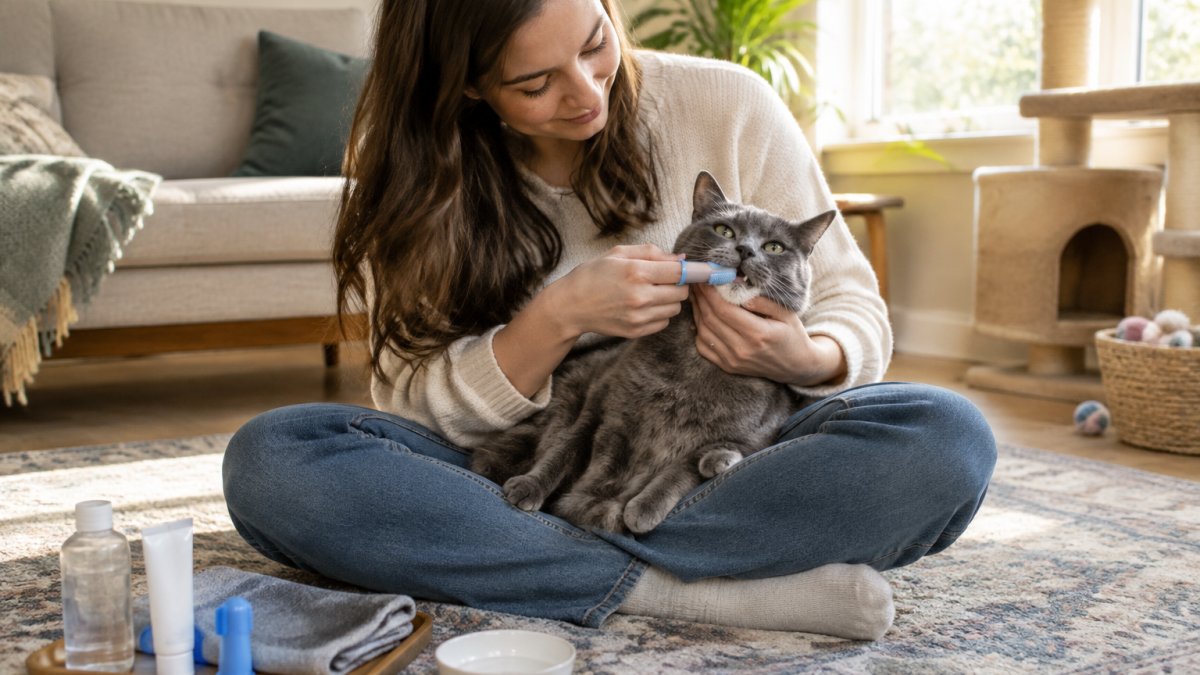
The trick is to stop treating it as a battle. Start with one tooth, one second, and a reward. Build from there over a couple of weeks.
- Let your cat lick the toothpaste off your finger first
- Slide a finger brush in for a single swipe along the outer gum line
- Work up to the back molars, where plaque builds fastest
- Brush at the same time each day so it becomes routine
A finger brush gives you the most control. Our 4-piece finger toothbrush kit uses soft silicone sleeves that slip over your fingertip, and the cat and dog finger toothbrush set is a compact alternative at 5 by 11.5 cm for reaching the back of the mouth.
Dental-care actions reported by cat owners
Dental Treats for Cats: Evidence Versus Marketing
Dental treats for cats work only when they carry a genuine dental claim and a texture that actually scrubs the tooth surface. Most treats sold as "dental" are simply low-calorie snacks with a shape that suggests cleaning.
The evidence gap is real. Dental treats were reported by just 23% of owners in the 2021 study, and the research on feline dental chews is thin. One 2019 study on developing dental hygiene chews for cats focused on feline dental anatomy and chewing patterns, and the published result gives no measurable efficacy figure.
How to tell a dental treat from a snack
- Look for a VOHC claim on the package. The VOHC accepted products list is the fastest way to separate a verified dental claim from a shape and a slogan. If the package does not carry the seal or name the claim, treat it as a snack.
- Check the texture, not the shape. A treat needs enough resistance to scrub the outer tooth surface without breaking apart on the first bite. Soft, quickly swallowed treats do not clean; they just add calories.
- Read the calorie count. Dental treats are still treats. A common pattern is that owners add them on top of the regular diet rather than subtracting food, which works against the dental benefit. Adjust the daily ration if you add them.
- Scan the ingredient list for red flags. The same rules that apply to toothpaste apply here: no xylitol, no fluoride, no unnamed "natural" blends. A treat that will not disclose its ingredients cannot be assessed for feline safety.
- Match the size to the cat. A treat sized for a dog is a choking risk for a cat and will not contact the right tooth surfaces. Choose a feline-specific size.
What treats can and cannot do
Treats are a supplement, never a substitute for brushing. They reach the outer surfaces of the teeth and do little for the gum line or the spaces between teeth, which is where periodontal disease starts. If your cat tolerates brushing, keep brushing as the base and use treats as a backup on days you miss.
Watch out: a treat labeled "dental" without a VOHC claim or a disclosed mechanism is marketing, not dentistry. Buying it is fine as a snack, but do not count it toward your cat's dental care.
Cat Dental Water Additive and Other Low-Effort Options
A cat dental water additive is a liquid you mix into drinking water to help reduce plaque and freshen breath. It is the lowest-effort option available, and that is both its appeal and its weakness.
The catch is evidence. Cornell's veterinary center notes there is not sufficient scientific data to support the effectiveness of dental sprays, though a carefully chosen spray is unlikely to cause harm.
Water additives: what to check before you pour
- Does your cat actually drink enough? A water additive only works if the cat drinks the treated water. Cats with low water intake, or cats that refuse changed water, get little benefit and may drink less, which is a welfare problem in itself.
- Is the formula feline-specific? Many water additives are sold for cats and dogs together. Check the label for a feline dose and a feline safety statement, not just a species-neutral claim.
- Are the ingredients disclosed and free of red flags? The same rules apply: no xylitol, no fluoride, no unnamed "natural" blends. If the label will not list what is inside, skip it.
- Does it carry a VOHC claim? Most water additives do not. That does not make them harmful, but it means the plaque or tartar benefit is unverified. Treat the product as breath support, not as proven plaque control.
- Will your cat accept the taste? A cat that rejects treated water may drink less, which is worse than no additive at all. Introduce it gradually and watch intake.
Sprays, gels and foams
These are contact products: they need to reach the tooth and gum line to do anything. A spray a cat swallows immediately, or a gel applied to the tongue rather than the gum line, is unlikely to help.
How to judge a low-effort product
Use a simple hierarchy. VOHC-listed dental diets and verified dental treats generally have stronger evidence than a water additive, spray, gel or foam.
Use these as backup, not as your plan. They are reasonable for cats that refuse brushing, for owners building a routine, or as a bridge until a veterinary exam.
Watch out: a water additive that makes your cat drink less is a net loss. If intake drops after you start, stop the product and try a different approach.
Comparing the Options: Cost, Effort and Evidence
Here is how the main categories stack up, so you can match the product to your cat and your schedule.
| Option | Effort | Evidence | Typical Cost | Best For |
|---|---|---|---|---|
| Finger brushing | High | Strongest | $14.95 | Owners who can commit daily |
| Dental treats | Low | Moderate | Varies | Supplementing brushing |
| Water additive | Very low | Limited | Varies | Cats who refuse brushing |
| Sprays and gels | Low | Limited | Varies | Short-term breath control |
| Dental diets | Low | Strong if VOHC-listed | Varies | Cats needing a food-based fix |
Cost is only part of the decision. If you are weighing pickup against delivery for these products, our pickup versus shipping cost comparison breaks down the difference before you buy.
When Home Care Is Not Enough
Home care has a ceiling. If your cat has bleeding gums, loose teeth, persistent bad breath or difficulty eating, that is a veterinary problem, not a product problem.
Periodontal disease can progress quietly in cats, and home care cannot reverse damage already done. A vet can assess what is happening under the gum line, which is where the real trouble sits.
Watch out: skipping professional checks because you brush daily is a common mistake. Brushing reduces risk; it does not replace an exam.
Building Your Cat's Dental Routine with Bentley's Bark
The routine that works is the one you will actually keep. Start with a finger brush and a feline-appropriate toothpaste, add treats or a water additive as backup, and book the vet visit you have been putting off.
At Bentley's Bark, we curate supplies for pet parents who want quality without guesswork. Every order ships free, our products are hand-picked under our Bentley Approved standard, and we focus on clean design and honest materials.
Get started with Bentley's Bark and build a dental routine your cat will tolerate, one tooth at a time.
A cat that fights the brush today can still learn to accept it next month. The difference is picking tools that fit, products with real evidence, and a pace your cat sets. Bentley's Bark stocks finger brushes, brush sets and gels with complimentary shipping on every order, so you can try a routine without overcommitting.
Frequently Asked Questions
What dental products are safe for cats?
Look for products carrying the Veterinary Oral Health Council (VOHC) Seal of Acceptance, which confirms a product has been shown to help control plaque or tartar. A feline dental guideline from the FelineVMA recommends safe and effective products, so check ingredients and avoid anything containing xylitol or human toothpaste ingredients. Soft finger brushes, feline-specific toothpaste, and low-calorie dental treats are the safest starting points. When in doubt, ask your veterinarian before introducing a new product.
Can cats use human toothpaste?
No. Human toothpaste often contains fluoride, xylitol, and foaming agents that cats should not swallow, and cats cannot rinse and spit. Use a toothpaste formulated for pets instead. A soft finger brush paired with a pet-safe gel keeps the routine simple. If you are unsure which paste suits your cat, your vet can confirm what is appropriate before you start brushing.
Are cat dental water additives safe and effective?
Water additives are generally low-risk when used as directed, but the evidence behind them is thinner than for brushing. They can help maintain fresher breath between brushings, yet they do not replace mechanical plaque removal. If your cat shares a water bowl with other pets or drinks little water, check with your vet first. Treat additives as a supplement to brushing, not a substitute.
How often should I brush my cat's teeth?
Daily brushing gives the best results, and feline dental guidance generally recommends regular plaque removal by brushing or wiping. If daily feels unrealistic at first, start with two or three sessions a week and build up. Consistency matters more than duration per session.