 How-to
Natural Flea and Tick Prevention for Cats That Works
Last Updated: November 11, 2026
Quick Summary
Natural flea and tick prevention for cats in Canada means using non-pesticide tools, grooming, and environmental control to reduce parasite exposure, and it works best as a layer rather than a replacement. Repellents shorten exposure but don't end infestations, so pair weekly flea combing and coat checks with vacuuming and hot-water bedding washes.
- Monk's pepper seed extracts repelled cat fleas for only about six hours, the honest ceiling for most plant-based repellents.
- Never apply a dog spot-on product to a cat, since permethrin and pyrethrins are very toxic to cats.
- Keep tea tree, citrus, pine, eucalyptus, wintergreen, peppermint, cinnamon, and clove oils off your cat and its bedding.
- Comb weekly during flea season, focusing on the neck, base of the tail, and behind the ears.
- Remove an attached tick with fine-tipped tweezers, pulling straight up slowly without squeezing or twisting.
Table of Contents
- Start With What Actually Works: Evidence Behind Natural Flea and Tick Prevention
- Safe Flea Treatment for Cats Begins With the Label
- Essential Oils Toxic to Cats: What Never Goes on Your Cat
- Using a Flea Comb for Cats: The Cheapest Check You Can Do
- How to Get Rid of Fleas in the House With Cats
- Tick Prevention for Cats and What to Do After a Tick Bite
- Building a Cat-Safe Prevention Routine That Fits Your Week
- Shop Cat-Safe Prevention Supplies at Bentley's Bark
- Frequently Asked Questions
Start With What Actually Works: Evidence Behind Natural Flea and Tick Prevention
Natural flea and tick prevention for cats in Canada is a category full of hope and short on proof. We sell the supplies, and we still won't tell you a bottle of essential oil replaces a proper parasite plan. Here's what the evidence actually supports.
A review of flea-control research, Recent Advancements in the Control of Cat Fleas, found that monk's pepper seed extracts repelled cat fleas for only about six hours. That's the honest ceiling for most plant-based repellents.
Natural flea and tick prevention for cats in Canada is the use of non-pesticide tools, grooming, and environmental control to reduce parasite exposure. It works best as a layer, not a replacement.
- Repellents shorten exposure, they don't end infestations
- Grooming catches problems early
- Home cleaning breaks the flea life cycle
Below, we walk through what's safe, what's marketing, and how to build a routine you'll actually keep.
Safe Flea Treatment for Cats Begins With the Label
Safe flea treatment for cats starts with reading the label, not the front of the bottle. The word "natural" on a flea or tick product is not a regulated claim, so it should not be taken as evidence of safety.
Watch out: permethrin and pyrethrins are very toxic to cats, according to the National Resources Defense Council. Some dog spot-on products contain permethrin. Never apply a dog product to a cat.
- Check for a Canadian pesticide registration number
- Look for a species listing that names cats
- Skip anything labeled "for dogs only"
If the label is vague, put it back on the shelf.
Essential Oils Toxic to Cats: What Never Goes on Your Cat
Essential oils toxic to cats deserve their own section because many oils that seem mild for people or dogs can be harmful to cats.
Oils that should never go on a cat, and should be kept off bedding and grooming tools the cat uses:
- Tea tree oil (Melaleuca alternifolia)
- Citrus oils, including d-limonene and linalool from orange, lemon, and lime
- Pine and eucalyptus
- Wintergreen (methyl salicylate)
- Peppermint and other concentrated mints
- Cinnamon and clove oils
Ingestion is the main exposure route, followed by skin contact and, for diffusers, inhalation in a closed room.
Watch out: a product sold as a "natural flea spray" with no species label and no Canadian pesticide registration number is a reason to be cautious.
If you want to use any oil near a cat, check the label for cat as the target species and for clear dilution and frequency directions. If any of those is missing, ask your veterinarian before first use.
Using a Flea Comb for Cats: The Cheapest Check You Can Do
A flea comb for cats is the cheapest and most reliable check you can run at home. One pass through the coat tells you more than any spray bottle.
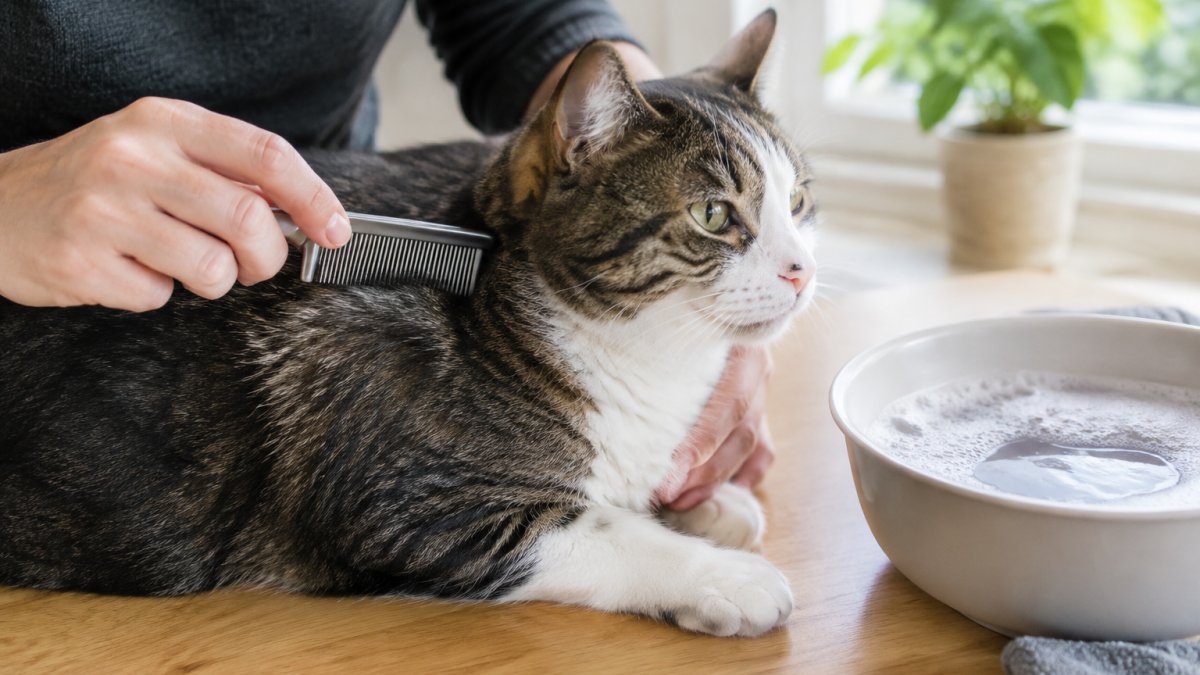
Comb weekly during flea season. Focus on the neck, the base of the tail, and behind the ears.
- Dip the comb in soapy water after each pass
- Watch for dark specks, which is flea dirt
- Wipe the comb dry between strokes
If you find live fleas, move to the next section. The house is usually the real problem.
How to Get Rid of Fleas in the House With Cats
How to get rid of fleas in the house with cats comes down to one fact: most of the flea population isn't on your cat. Eggs and larvae live in carpet, bedding, and cracks. You have to clean where they hide.
Start with the vacuum. Go over carpets, rugs, and under furniture. Then wash pet bedding in hot water.
- Vacuum daily during an active infestation
- Wash bedding weekly
- Steam clean carpets where possible
- Keep the litter area clean and dry
For carpets, see our guide to pet-safe carpet cleaning alternatives. An odour-eliminating litter box starter kit also helps you keep the home environment under control while you treat the infestation.
Tick Prevention for Cats and What to Do After a Tick Bite
Tick prevention for cats matters more than most owners think. Ticks hitch rides indoors on cats and can carry disease. Check the coat after every outdoor trip, and check even indoor-only cats that share a home with a dog or a person who walks in tall grass.
Run your hands over the head, ears, and neck. Feel for a small bump. Ticks favor thin skin: around the ears, at the jawline, and along the neck. A tick that is small and flat has likely just attached; one that is gray and swollen has been feeding for a while.
If you find an attached tick, don't squeeze it. Squeezing can push saliva into the cat and raise the risk of transmission.
- Use fine-tipped tweezers
- Grasp as close to the skin as you can
- Pull straight up, slowly, without twisting
- Save the tick in a sealed container or a zip bag with the date
- Clean the bite area with mild soap and water
- Wash your hands
Do a coat check every time your cat comes inside, and log the date of any bite you find.
After removal, watch the bite site and the cat's behavior for the next two to four weeks. Signs that warrant a call to your veterinarian include:
- A red or expanding ring or persistent redness at the bite site
- Lethargy, hiding, or a drop in appetite
- Fever, limping, or reluctance to jump
- Vomiting or diarrhea that persists
- Any weakness or change in gait
Watch out: a tick bite does not always produce a visible mark, so a cat that becomes lethargic or lame weeks after outdoor exposure still deserves a veterinary check even if you never found a tick.
Bring the saved tick to the appointment if you can. Your veterinarian can advise on a preventive plan that fits your cat's age and lifestyle.
Building a Cat-Safe Prevention Routine That Fits Your Week
A cat-safe prevention routine works when it fits your actual week. Ours is simple and repeatable.
| Task | How Often | Time |
|---|---|---|
| Flea comb check | Weekly | 5 minutes |
| Coat check for ticks | After outdoor time | 2 minutes |
| Vacuum high-traffic areas | 2-3 times weekly | 10 minutes |
| Wash pet bedding | Weekly | 5 minutes |
| Vet check on any product | Before first use | Varies |
Time
Season matters here. Flea and tick activity climbs in warm months, so tighten the routine from spring through fall. Ease off in deep winter, but don't stop checking.
Shop Cat-Safe Prevention Supplies at Bentley's Bark
At Bentley's Bark, we offer a curated selection of supplies for cats, including grooming and home products designed to solve real pet-parent problems.
- A curated selection of cat-safe products
- Complimentary shipping on every order
- Bentley Approved hand-picked items
Not sure where to start? Our premium pet supplies guide and our curated guide to quality cat supplies walk you through choosing well. If you'd rather skip the big marketplaces, see our Amazon alternatives for pet owners.
Fleas and ticks don't wait for a perfect plan. Build the routine this week, start with a comb and a vacuum, and add supplies you trust. Bentley's Bark offers a curated selection, Bentley Approved picks, and complimentary shipping on every order. Get started with Bentley's Bark and give your cat a calmer, cleaner season.
Frequently Asked Questions
Do natural flea remedies actually work for cats?
Some show limited, short-lived effects. Treat natural flea and tick prevention as a support layer alongside combing, vacuuming, and washing bedding, not as a replacement for veterinary guidance.
Which essential oils are toxic to cats?
Cats process many plant compounds differently from dogs, so essential oils carry real risk. A Canadian veterinary clinic notes that natural flea and tick products may include essential-oil sprays, and that natural is not a regulated claim. The National Resources Defense Council warns that permethrin and pyrethrins are very toxic to cats. Check with your veterinarian before applying any essential oil product to your cat or its bedding.
How often should I use a flea comb on my cat?
During flea season, comb your cat regularly. Run the fine-toothed comb against the direction of the coat, dip what you collect in soapy water, and check the comb for flea dirt, the dark specks that turn reddish when wet. Keep sessions short and reward your cat so it stays a calm routine.
Can indoor cats get fleas or ticks?
Yes. Fleas can be brought into a home on people, dogs, and secondhand furniture. Ticks can arrive on clothing or on a dog that shares the household. That is why how to get rid of fleas in the house with cats matters even for cats that never go outside: vacuum floors and crevices, wash pet bedding in hot water, and check your cat weekly. If you find fleas or ticks, ask your veterinarian about a safe flea treatment for cats before trying home remedies.