 How-to
How to Read Pet Food Labels for Quality Ingredients
Quick Summary
To read pet food labels for quality ingredients, start with the back panel, not the front marketing. Check that the ingredient list names specific protein sources, confirm the adequacy statement fits your pet's life stage, and compare guaranteed analysis on a dry-matter basis.
- The front of the bag is marketing; the back panel holds the facts.
- Ingredients are listed by descending weight, so the first ingredient makes up the largest share.
- Named ingredients like chicken or salmon are easier to evaluate than vague terms like meat.
- Compare guaranteed analysis on a dry-matter basis to fairly assess wet and dry foods.
- Check that the adequacy statement names your pet's life stage and states how it was confirmed.
Table of Contents
- Start With the Product Name and Label Claims
- Pet Food Ingredient List Explained: Order, Weight and Named Ingredients
- Complete and Balanced Pet Food Meaning: Reading the Adequacy Statement
- Pet Food Guaranteed Analysis Explained: Comparing on a Dry-Matter Basis
- Calories, Feeding Directions and Life Stage: The Practical Details
- How to Compare Pet Food Brands With a Label Checklist
- Your Next Step: Shopping With a Label Checklist in Hand
- Frequently Asked Questions
Start With the Product Name and Label Claims
Last Updated: November 16, 2026
Most pet parents glance at the front of a bag of pet food labels and decide in seconds. That is the first mistake: the front panel is marketing, the back panel is where the facts live.
Pet food is regulated in Canada, and the Canadian Food Inspection Agency (CFIA) sets the rules for how labels must be written and what they must say.
The product name is not a promise. Canadian rules restrict how much a named ingredient can appear in a product name, depending on the wording.
Label claims need a closer look. Phrases like "natural," "premium," "grain-free," or "vet recommended" appear on many bags. Some have specific meanings under regulation, others do not.
Here is a quick way to start:
- Find the product name and note any ingredient percentage in it
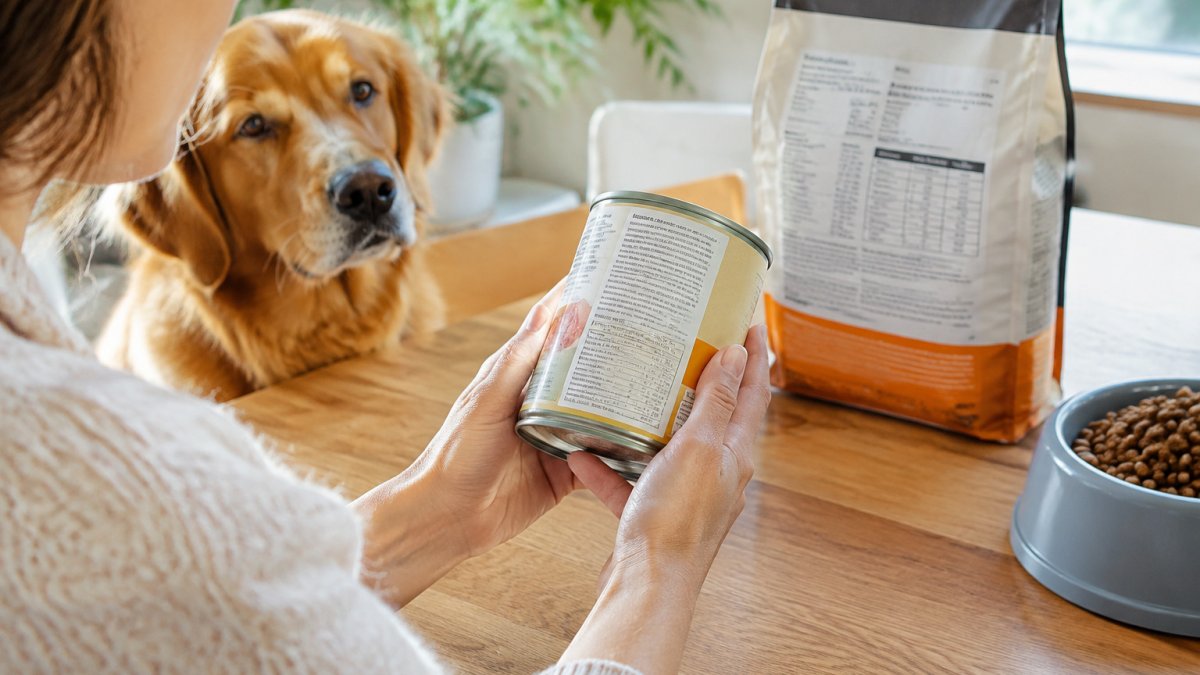
- Read the front claims, then flip the bag over
- Locate the ingredient list, guaranteed analysis, and adequacy statement
- Check that the claims match what the back of the label says
Pet Food Ingredient List Explained: Order, Weight and Named Ingredients
The ingredient list is the most useful part of the label, but only if you read it correctly. Ingredients are listed in descending order by weight, as they go into the food before cooking, so the first ingredient makes up the largest share (List of ingredients and allergens on food labels).
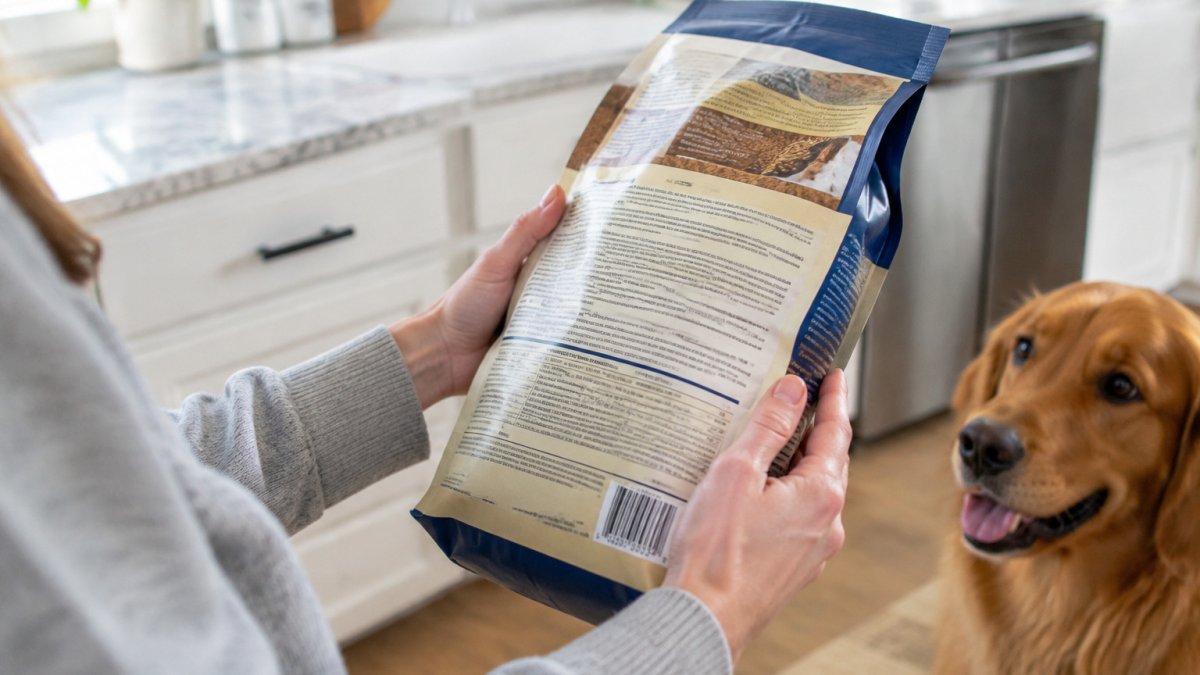
Pay attention to named ingredients. A named ingredient, such as "chicken," "lamb," or "salmon," tells you the exact animal source. Vague terms like "meat" or "animal protein" leave you guessing. Named sources are easier to evaluate.
Watch for splitting. Some manufacturers split one ingredient into several forms, such as "peas," "pea protein," and "pea fiber." Each form appears lower on the list, making peas look less prominent than they are. Adding up all forms gives a clearer picture of the real share.
What Ingredient Names and Categories Mean
Ingredient names follow regulatory conventions, and knowing the common ones helps you decode the list.
- Meal (for example, "chicken meal"): protein with moisture removed, so it adds protein density.
- By-product: parts of the animal beyond muscle meat, such as organs. These can be nutritious, but the label should name the source.
- Digest: flavor ingredients made by breaking down animal tissue, often used for palatability.
- Whole grains (such as brown rice or oats): carbohydrate sources that also provide fiber.
- Vitamins and minerals: added to meet nutrient needs; their presence alone does not signal quality.
Watch out: A long list of unfamiliar chemical names does not automatically mean low quality, many added vitamins and minerals have long names. Judge a product on its named protein sources, overall balance, and manufacturer transparency.
Complete and Balanced Pet Food Meaning: Reading the Adequacy Statement
The nutritional adequacy statement is one of the most important lines on a pet food label. It tells you whether the food is designed to meet nutrient needs for a specific life stage.
In Canada, a statement typically says the food is "complete and balanced" for a stated life stage, such as growth, adult maintenance, or all life stages. Look for two things:
- The life stage the food is formulated for
- The method used to confirm the claim, either formulation based on recognized nutrient profiles or feeding trials
A food labeled for "all life stages" can suit most pets, but puppies and kittens have higher needs for growth. For a young pet, choose a product designed for growth. For a senior pet, check whether the food is formulated for maintenance or specifically for older pets.
Here is a short checklist for the adequacy statement:
- The statement names a life stage that fits your pet
- The food is labeled as complete and balanced
- The statement says how the claim was confirmed
- The label is for a food, not a treat or topper
Treats and toppers do not need to be complete and balanced. Using a treat as a main meal can leave gaps in your pet's diet.
Pet Food Guaranteed Analysis Explained: Comparing on a Dry-Matter Basis
The guaranteed analysis lists minimum protein and fat, and maximum fiber and moisture. These are guarantees, not exact amounts, reported as "as fed" percentages.
A wet food with 78% moisture can show low protein percentages, even when the food is protein-rich once the water is removed.
The fix is to compare on a dry-matter basis. Here is the full method:
- Subtract the moisture percentage from 100 to find the dry matter percentage.
- Divide each nutrient percentage (such as protein) by the dry matter percentage.
- Multiply by 100 to get the dry-matter value.
- Canned food: dry matter is 100 − 78 = 22%. Protein on a dry-matter basis is 10 ÷ 22 × 100 ≈ 45%. Fat is 6 ÷ 22 × 100 ≈ 27%.
- Dry food: dry matter is 100 − 10 = 90%. Protein on a dry-matter basis is 26 ÷ 90 × 100 ≈ 29%. Fat is 15 ÷ 90 × 100 ≈ 17%.
On the bag, the dry food looks higher in protein (26% versus 10%). On a dry-matter basis, the canned food is actually higher in both protein and fat.
How to read the results. There is no universal "good" dry-matter protein number, because needs vary by species, life stage, and health.
A shortcut for fiber and ash. The same division works for any nutrient on the label, including fiber.
Many pet parents find this calculation tedious, so use it when two products are close and you want a real comparison. Canadian labels list moisture, which makes the math possible. If a label omits moisture, ask the manufacturer before relying on the comparison.
Calories, Feeding Directions and Life Stage: The Practical Details
Calorie content matters as much as nutrient content. Overfeeding is one of the most common problems for pets, and calorie-dense foods make it easy to overfeed.
Look for the calorie statement, usually given as kilocalories (kcal) per kilogram or per cup or can. Compare calorie values on a per-weight basis when you can, because serving sizes vary.
Feeding directions are a starting point. The amounts printed on the bag are general guides based on body weight.
Life stage affects both calories and nutrient needs. Here is a quick summary:
| Life Stage | What to Check |
|---|---|
| Growth (puppy or kitten) | Labeled for growth or all life stages |
| Adult maintenance | Labeled for adult maintenance |
| Senior | Check calories and fiber for lower activity |
When to consult a veterinarian: if your pet has a health condition, is losing or gaining weight without explanation, or needs a special diet, ask your vet before switching foods.
How to Compare Pet Food Brands With a Label Checklist
Comparing brands is easier when you use the same checklist for every product. Many pet parents compare on price or marketing alone, but a structured review gives better results.
Step 1: Read the label in order. Work front panel to back panel so you do not anchor on a marketing claim.
- Product name and any ingredient percentage statement match the ingredient list
- Named protein is the first or second ingredient
- Ingredient sources are named, not vague ("chicken" rather than "meat")
- Adequacy statement matches your pet's life stage and states the method used
- Guaranteed analysis is compared on a dry-matter basis
- Calorie content is listed per kilogram and per common serving
- Feeding directions are clear and include a range by weight
- Manufacturer name and contact information appear on the label
Step 2: Evaluate manufacturer transparency. This is the part most label guides skip, and it is where brands separate. A label is a snapshot; the company behind it determines whether the snapshot stays accurate batch to batch. Ask these questions by phone or email, and note how readily the answers come:
- Who formulates the food? Look for a named board-certified veterinary nutritionist or qualified animal nutritionist on staff, rather than an unnamed formulator.
- Where is the food made, and by whom? A brand that owns its manufacturing has more control than one that contracts to an unknown co-packer. Either can be fine, but the brand should be able to tell you which it is.
- What testing is done? Ask whether finished products are tested for nutrient content and contaminants, and how often. Transparent brands describe testing in specific terms rather than general assurances.
- How are suppliers chosen and verified? Named ingredient suppliers and stated sourcing standards are a stronger signal than "high-quality ingredients."
- How do they handle formula changes and recalls? A brand should explain how it communicates changes and what its recall process is.
Step 3: Weigh the whole picture. Ingredient quality is not the same as list order.
Watch out: A brand that cannot or will not answer basic questions about formulation, manufacturing, or testing is telling you something. Weigh that silence carefully rather than filling the gap with assumptions.
At Bentley's Bark, we carry treats such as the Steak Thins Dog & Cat Treats at $14.99 CAD for 50g, which list lean beef eye of round as the ingredient, and the Venison Heart Thins Dog & Cat Treats at $14.99 CAD for 50g, which list lean venison heart.
Your Next Step: Shopping With a Label Checklist in Hand
Reading labels takes practice, but the steps get faster each time. Start with the product name, check the ingredient list order and named sources, confirm the adequacy statement matches your pet, and compare the guaranteed analysis on a dry-matter basis.
Keep this checklist on your phone for your next shopping trip. Use it on every product, including the ones you already trust, because formulas change over time. When a label raises questions, ask your veterinarian before switching.
Bentley's Bark curates pet supplies for dogs and cats, with complimentary shipping on every order. Bring the checklist with you, then browse our curated selection to find products you can feel good about.
Frequently Asked Questions
How do you read a pet food label?
Start with the product name, then check the ingredient list, the guaranteed analysis, the complete and balanced statement and the feeding directions. Read the product name to see how much of the named ingredient it contains, since the percentage rules change the meaning of a name like 'beef recipe' versus 'with beef'. Work through each section in that order so you can compare products on the same terms rather than on marketing language.
What should you look for in quality pet food ingredients?
Look for named animal proteins such as 'chicken' or 'lamb' rather than vague terms like 'meat by-products', and check that the first few ingredients include a named meat source. Ingredient order reflects weight before cooking, so moisture in fresh meat can make it appear higher than it is in the finished dry food. Pair the ingredient list with the guaranteed analysis and manufacturer information to judge overall quality rather than relying on order alone.
How can you tell if pet food is nutritionally complete?
Find the nutritional adequacy statement, which should say the food is 'complete and balanced' for a specific life stage such as adult maintenance or growth. The statement indicates whether the formula meets the nutrient profiles set out by the Association of American Feed Control Officials, or whether it was tested in a feeding trial. If the statement is missing or only says 'for intermittent or supplemental feeding,' the food is not meant to be a sole diet.
How can you compare two pet food labels?
Convert the guaranteed analysis of each product to a dry-matter basis so moisture content does not distort the comparison, which matters most when one food is wet and the other is dry. Then compare calorie content per cup or per can, the protein and fat levels, and whether each food suits the same life stage. Use the checklist in this guide to score both labels on the same criteria before deciding.