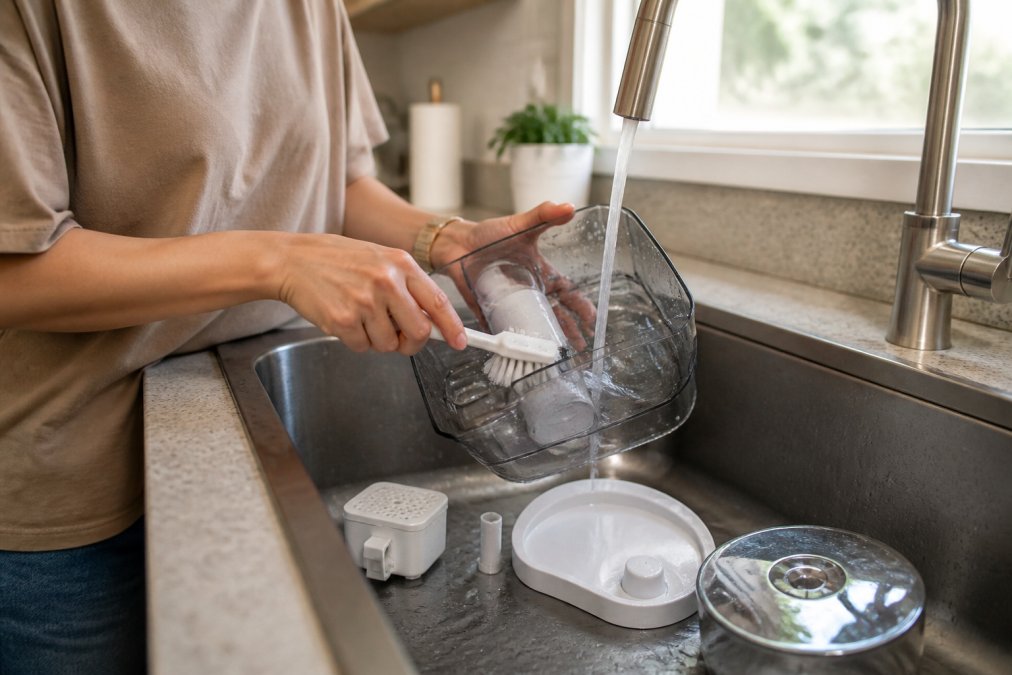
 how-to
How to Clean an Automatic Pet Water Fountain (2026 Guide)
Table of Contents
- Why Regular Cleaning Matters for Your Pet's Health
- What You'll Need: Tools and Supplies for Pet Water Fountain Cleaning
- Step-by-Step Guide: How to Clean an Automatic Pet Water Fountain
- Pet Water Fountain Cleaning Frequency: How Often Is Enough?
- How to Remove Slime from Cat Water Fountain (and Prevent It)
- Pet Water Fountain Filter Replacement Schedule
- Common Mistakes to Avoid When Cleaning Your Fountain
- Frequently Asked Questions
Last Updated: September 14, 2026
Why Regular Cleaning Matters for Your Pet's Health
Learning how to clean automatic pet water fountains properly is one of the most overlooked parts of pet ownership, and it matters more than most people realize. A fountain that runs for weeks without a full teardown becomes a breeding ground for bacterial biofilm, a slick layer of microorganisms that clings to plastic surfaces and circulates straight back into your pet's drinking water. Cats are especially vulnerable because they're notoriously fussy drinkers: a fountain that smells or tastes off gets ignored, and reduced water intake raises the risk of urinary and kidney problems down the road (pubmed.ncbi.nlm.nih.gov).
At Bentley's Bark, we hear from pet parents who assume that because the water is moving, it must be clean. It isn't. The pump keeps water circulating, but it also keeps bacteria, saliva, and food particles circulating with it. The Canadian Veterinary Medical Association's pet care resources notes that clean, fresh water is a basic requirement for companion animal health, and a fountain left uncleaned for too long undermines exactly that.
Below, we'll walk through disassembly, deep cleaning, descaling, and re-assembly, plus how often to do it all.
What You'll Need: Tools and Supplies for Pet Water Fountain Cleaning
Gather everything before you start, because a half-cleaned fountain that sits apart for an hour is worse than no cleaning at all. Here's what actually works:
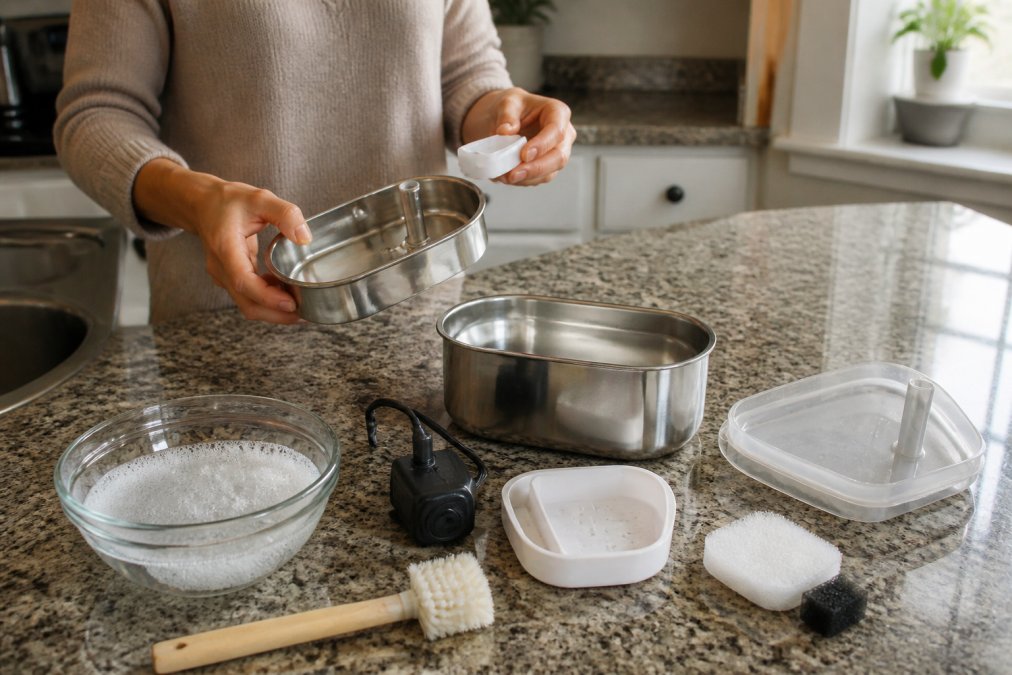
- Soft-bristled brush (a dedicated bottle brush or the one that came with your fountain)
- Cotton swabs or a small detail brush for impeller crevices
- Pet-safe dish soap (unscented, non-toxic)
- White vinegar for descaling
- Baking soda for stubborn residue and odor
- Warm water and a clean towel
- Gloves if you're squeamish about slime, which is fair
Skip abrasive sponges on any plastic fountain reservoir: they scratch the surface and give bacterial biofilm a foothold that no amount of scrubbing removes later.
Step-by-Step Guide: How to Clean an Automatic Pet Water Fountain
The full process takes about 20 to 30 minutes, and doing it right once a week beats a rushed scrub every day. Work at the kitchen sink with everything within reach, and keep a small container of clean water nearby for testing the pump before it goes back in the fountain.
Step 1: Unplug and Disassemble the Fountain
Unplug the fountain first. Always. Water and live electronics don't mix, and the pump can be damaged if it runs dry while you're working. Lift out the top tray, remove the charcoal filter, and separate the reservoir, filter housing, spout, and pump. Lay the parts out in order so re-assembly is straightforward. If your fountain has a stainless steel basin, set it aside separately from the plastic components, stainless can take a slightly firmer scrub, while plastic needs a lighter touch to avoid micro-scratches that harbor biofilm.
Step 2: Clean the Basin and Filter Housing
Wash the basin, tray, and filter housing in warm water with a few drops of pet-safe dish soap. Use the soft-bristled brush to work around the edges and corners where slime buildup collects. Rinse thoroughly, because soap residue will put your pet off drinking. For the filter housing, a cotton swab gets into the narrow channels where debris settles.
Material matters here. Stainless steel basins tolerate hot water and a firmer brush and won't scratch. BPA-free plastic reservoirs scratch easily, so use only a soft brush and lukewarm water, hot water can also warp thinner plastic housings over time. Ceramic fountains are the easiest to sanitize but the most fragile: check for hairline cracks around the spout and base, because a cracked ceramic reservoir will leak onto the pump and shorten its life.
Step 3: Deep Clean the Pump Motor and Impeller
This is the step most guides skip, and it's the one that matters most. The impeller housing, the small chamber behind the pump's front cover, is where the heaviest slime accumulates, because it's the one area water moves through fastest and where hair, fur, and food particles collect.
Here's how to open it safely:
- Unplug the pump and lift it out of the reservoir. Never work on a pump that's still connected.
- Locate the front cover. On most submersible fountain pumps this is a small clip-on plate held by two plastic tabs. Press the tabs inward and lift the cover straight off, don't pry with a screwdriver, which cracks the housing.
- Pull the impeller. The impeller is the small magnetic rotor with blades. It usually lifts straight out of its shaft. Set it aside on a paper towel.
- Clear the intake and impeller well. Use a cotton swab or a small detail brush to remove the ring of slime, hair, and grit that collects around the impeller shaft and the intake grate. This ring is the single most common cause of weak water flow.
- Wipe the motor housing with a damp cloth. Never submerge a motor that isn't rated for full immersion, check the pump label or manual, because some fountain pumps are only rated for the impeller and intake to be wetted.
- Reassemble the impeller and cover and seat the pump back in its bracket.
Step 4: Descaling Hard Water and Mineral Deposits
Hard water leaves calcium buildup and white mineral deposits on fountain surfaces, and in many households that happens within a couple of weeks. Left alone, scale roughens plastic and stainless surfaces, giving biofilm a textured foothold that a soft brush can't fully clear.
Use a 1:1 white vinegar and water solution (Preventing and Treating the Dezincification of Brass - Canadian Conservation Institute...). Submerge the affected parts, basin, tray, spout, and impeller cover, for 15 to 30 minutes. For light film, 15 minutes is enough; for visible white crust, go the full 30 and scrub gently with the soft brush afterward. Rinse thoroughly, because vinegar residue is acidic and your pet will notice it.
For stubborn scale, make a paste of baking soda and water, apply it to the deposit, and let it sit for ten minutes before rinsing. Baking soda is mildly abrasive and works well on ceramic and stainless; use a lighter touch on plastic to avoid dulling the surface.
Never mix vinegar and baking soda in the same container. The two neutralize each other on contact, you'll get foam and no descaling benefit. Use them in sequence, not together.
A note on commercial descalers: many contain citric or sulfamic acid and are safe for stainless and ceramic, but some formulations can cloud or craze certain plastics. If you use one, test it on a hidden area of the reservoir first, and rinse more thoroughly than you think you need to.
Step 5: Re-assemble and Test Water Flow
Rinse every part thoroughly under running water, then dry with a clean towel. Reinstall the charcoal filter (a fresh one if it's due), seat the pump, and refill the reservoir with fresh water. Plug it in and watch the water flow for a full minute. You want a steady, even stream with no sputtering. A noisy pump usually means trapped air or a loose impeller cover, unplug, reseat the cover, and try again before assuming the pump has failed.
Pet Water Fountain Cleaning Frequency: How Often Is Enough?
A full teardown and deep clean once a week is the right baseline for most households. Between deep cleans, empty and refill the reservoir daily and give the basin a quick rinse every two or three days.
Adjust upward in these situations:
- Multiple pets sharing one fountain: clean every 3 to 4 days
- Raw or wet food diets: more debris ends up in the water, so clean more often
- Warm, humid months: bacterial biofilm grows faster
- Visible slime or cloudiness: clean immediately, don't wait for the schedule
If you have both a dog and a cat, expect the cat's fountain to need more attention. Cats are messier drinkers than most people assume, and they'll abandon a fountain long before a dog would.
How to Remove Slime from Cat Water Fountain (and Prevent It)
Slime is bacterial biofilm, and it forms on every fountain surface that stays wet, no matter how clean the water looks. The slick layer you feel on the reservoir wall is a colony of microorganisms held together by a self-produced matrix that sticks to plastic, stainless, and ceramic alike. Scrubbing removes the visible layer, but if you don't break the conditions that let it regrow, it returns within days.
To remove it, disassemble the fountain, scrub every surface with a soft-bristled brush and pet-safe dish soap, then soak the parts in a 1:1 vinegar solution for 15 minutes. Pay extra attention to the impeller housing and the filter housing channels, those are the two spots where biofilm survives a casual rinse. Rinse thoroughly before re-assembly.
Prevention comes down to four habits, not three:
- Rinse daily, even when you don't do a full clean. A 30-second rinse of the basin and tray removes the food particles and saliva that feed biofilm.
- Replace the filter on schedule, since a saturated charcoal filter stops trapping organics and starts releasing them back into the water.
- Keep the pump running, because stagnant water in a switched-off fountain grows slime faster than moving water.
- Match your cleaning method to the material. Plastic scratches and holds biofilm in the scratches; stainless is smoother and easier to fully clear; ceramic is the easiest to sanitize but chips and cracks, and a cracked surface is a permanent biofilm trap.
If slime returns within two or three days of a full clean, the cause is usually one of three things: the filter is overdue, the impeller housing wasn't opened and cleaned, or the fountain is running in a warm spot that accelerates bacterial growth. Fix the cause, not just the symptom.
Pet Water Fountain Filter Replacement Schedule
Most charcoal filters need replacing every two to four weeks, or sooner in a multi-pet home. Check your fountain's manual for the specific interval, because filter size and pump flow rate both affect how quickly a filter saturates.
Replace the filter immediately if you notice:
- Reduced water flow despite a clean impeller
- A musty or stale smell from the reservoir
- Visible discoloration or debris on the filter surface
- It's been more than a month since the last change
Buying filters in multi-packs saves money and, more importantly, means you're never tempted to stretch a filter "just one more week."
Common Mistakes to Avoid When Cleaning Your Fountain
The most damaging mistake is cleaning the pump housing with soap and not rinsing it fully. Residual soap film is invisible but your pet can smell it, and a fountain that suddenly stops being used is often a soap problem, not a health problem.
Other frequent errors:
- Skipping the impeller. A clean basin with a fouled impeller still underperforms.
- Using abrasive scrubbers on plastic, which creates scratches that harbor bacteria.
- Letting parts air-dry before re-assembly, which leaves mineral spots that seed new buildup.
- Topping up instead of emptying. Refilling over old water concentrates minerals and debris.
If you're upgrading your setup, a second reservoir or a spare set of bowls makes rotation easier: our Stainless Steel Dog and Cat Food Bowls for Pets are easy to rinse and pair well with a fountain-based routine, and every Bentley's Bark order ships free.
Frequently Asked Questions
How often should I clean my automatic pet water fountain?
A full deep clean once a week is ideal for most households. If you have multiple pets or notice slime buildup, clean every 3-4 days. Daily tasks include rinsing the basin and topping up water. Regular cleaning prevents bacterial biofilm and keeps water fresh, supporting your pet's hydration health. Always unplug the fountain before cleaning.
What is the best way to remove slime from a cat water fountain?
Slime is bacterial biofilm. To remove it, disassemble the fountain and soak all parts in a 1:1 vinegar solution for 15 minutes. Scrub with a soft-bristled brush, paying attention to corners and the impeller area. Rinse thoroughly with warm water. For stubborn spots, make a paste with baking soda and scrub gently. Clean weekly to prevent slime from returning.
Can I put my pet water fountain parts in the dishwasher?
Always check the manufacturer's instructions for your specific pet water fountain parts. The pump motor and any electrical components must never go in the dishwasher. Hand-wash the pump with a soft brush and warm soapy water. High heat can warp plastic and damage seals, so hand washing is often safer.
How often should I replace the filter in my pet's water fountain?
Replace the charcoal filter every 2-4 weeks, depending on use and water quality. If you have multiple pets or notice reduced water flow, replace it sooner. Hard water areas may require more frequent changes due to mineral deposits. Always rinse the new filter thoroughly before use to remove loose charcoal dust. A clean filter ensures fresh, clean water.
Keeping a fountain genuinely clean is a weekly commitment, not a one-time task, and the payoff is a pet that actually drinks enough water. Bentley's Bark curates the smart gadgets and feeding essentials that make that routine easier, from easy-to-clean stainless steel bowls to the accessories that keep your home tidy. Explore the collection and get free shipping on every order, so your pet's hydration stays simple from day one.