 How-to
How Big Should a Cat Scratching Post Be?
Last Updated: November 21, 2026
Quick Summary
The best cat scratching post height for most adult cats is 76 to 81 centimetres of usable vertical surface, which lets a cat stand on its hind legs and stretch fully overhead. Measure from the floor to the highest point your cat's front claws reach while scratching, and use that number as your minimum post height.
- A post listed at 81 centimetres may offer only 66 centimetres of scratchable surface once you subtract the base and top cap.
- A 71-centimetre post is a reasonable fit for smaller adults and many seniors.
- The base should be at least half the post's height in each direction, so an 81-centimetre post requires a base around 40 centimetres square or wider.
- A kitten can start on a post around 45 to 61 centimetres and move up as it grows.
- Multi-cat homes should offer at least one scratching location per cat, spread across different rooms.
Table of Contents
- Start by Measuring Your Cat, Not the Shelf Tag
- Cat Scratching Post Height: The 76 to 81 Centimetre Rule
- Vertical vs Horizontal Cat Scratchers: Which Does Your Cat Want?
- Cat Scratching Post Materials: Sisal, Felt, Carpet, or Cardboard
- Finding the Best Cat Scratching Post for Large Cats
- Stability, Base Size, and Usable Scratching Area
- Kittens, Senior Cats, and Multi-Cat Homes
- Pick a Post That Fits Your Cat and Your Room
- Frequently Asked Questions
Start by Measuring Your Cat, Not the Shelf Tag
Choosing the right cat scratching post for your cat's size starts with your cat, not the product page. A post that is too short forces your cat to scratch in a crouch, and most cats will abandon it for your sofa instead. Bentley's Bark provides resources to help owners understand how tall and how long their cat actually stretches.
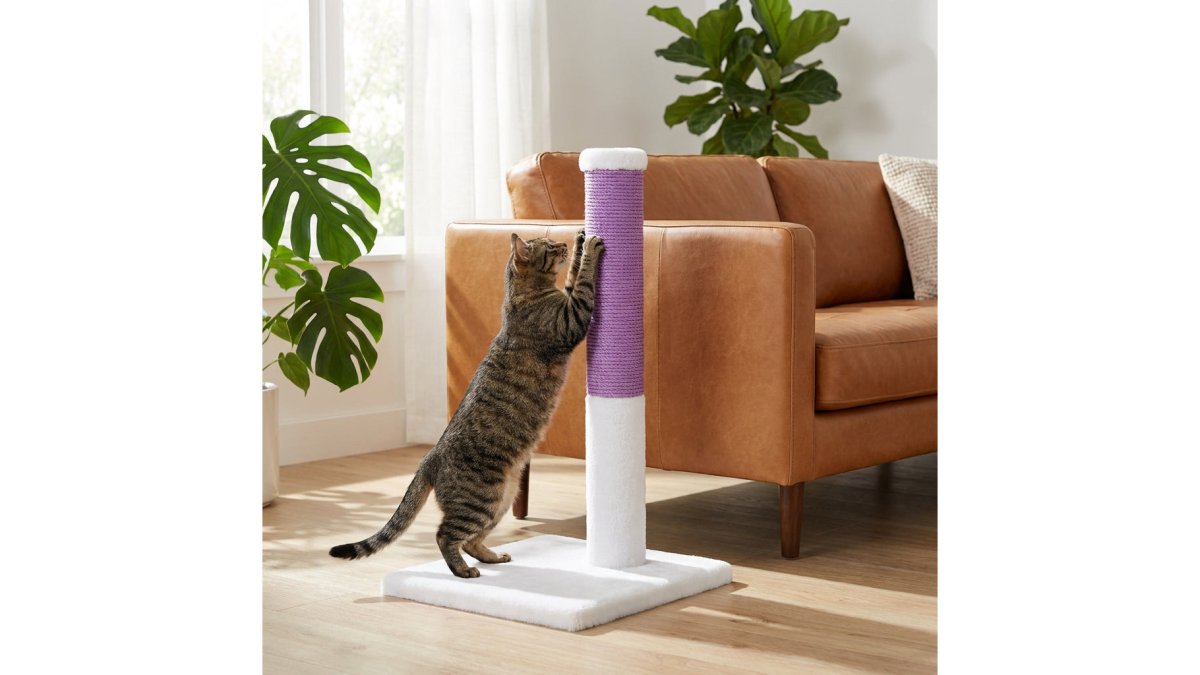
The full-body stretch test takes about a minute.
The full-body stretch test
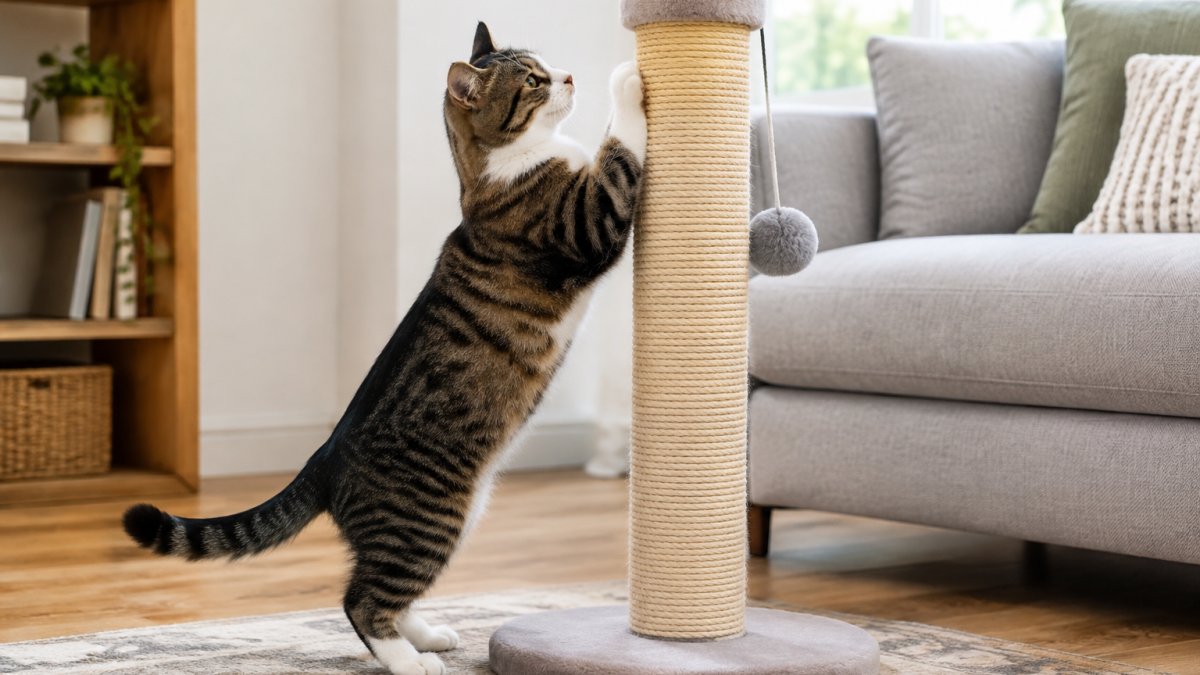
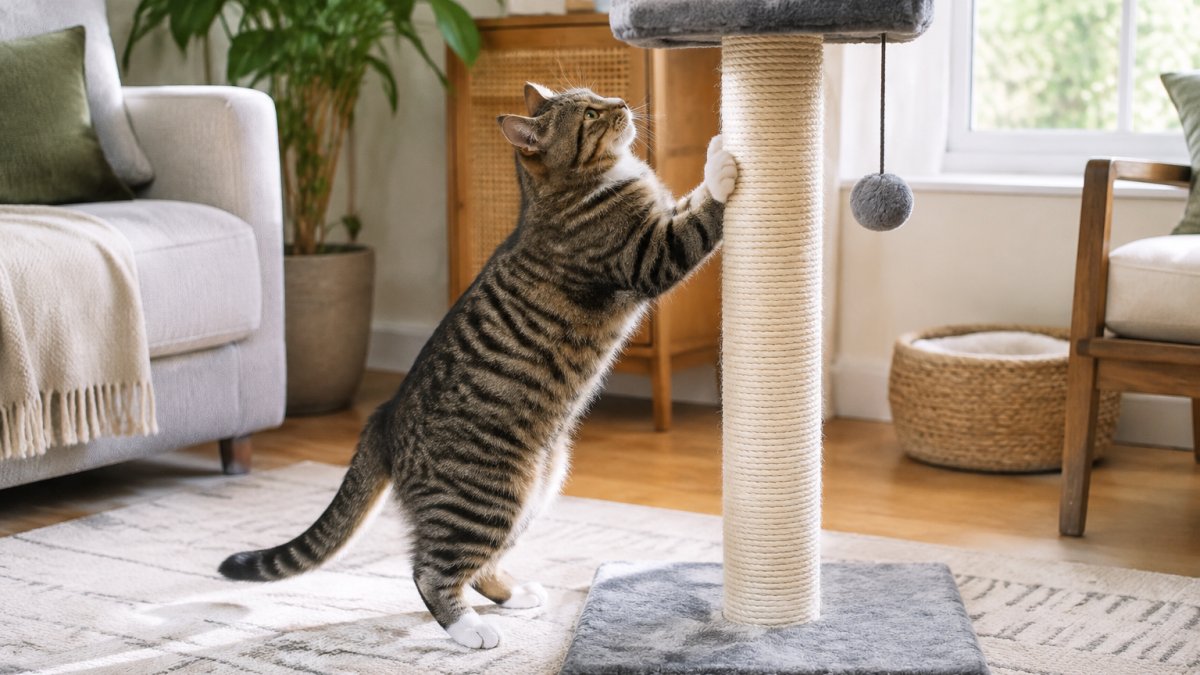
Watch your cat scratch something they already love. A healthy adult cat should be able to plant its hind legs on the floor and reach its front paws overhead without bending its spine. Measure from the floor to the highest point those front claws reach. That number is your minimum post height.
If your cat scratches horizontally, on a rug or a door frame, measure the length of the stroke instead. A horizontal scratcher should let the cat extend front to back without running out of surface.
Reading the numbers on a product listing
Product listings mix usable height with total height, and that gap matters. A post listed at 81 centimetres may only offer 66 centimetres of scratchable surface once you subtract the base and top cap.
Check three numbers before you buy:
- Usable scratching height or length, not the overall product height
- Base dimensions, which determine stability
- Surface material, since rope, felt, and cardboard wear differently
Cat Scratching Post Height: The 76 to 81 Centimetre Rule
The best cat scratching post height for most adult cats is 76 to 81 centimetres of usable vertical surface. That lets a cat stand on its hind legs and stretch fully overhead, which is the position that does the most for muscle tone and claw health. According to Pet industry growth trends in Canada, the demand for ergonomic pet furniture continues to rise.
A 71-centimetre post is a reasonable fit for smaller adults and many seniors. The Noba Classic 28" Scratching Post in white faux fur is built on particle board with a fique rope wrap and a faux fur base, and it suits cats that stretch a little less than the 81-centimetre benchmark.
Vertical vs Horizontal Cat Scratchers: Which Does Your Cat Want?
Vertical vs horizontal cat scratchers comes down to how your cat already scratches. Vertical posts suit cats that rear up and pull downward. Horizontal scratchers suit cats that stretch forward and rake the surface. Watch for the tell: a cat that claws the side of the sofa is a vertical scratcher. One that shreds the carpet runner is horizontal.
If you are leaning vertical, the vertical cat scratching post with corrugated paper house gives your cat a dedicated post plus a hideaway to evaluate.
Cat Scratching Post Materials: Sisal, Felt, Carpet, or Cardboard
Cat scratching post materials decide how long the post lasts and whether your cat uses it at all. Rope and sisal give a rough, satisfying resistance. Felt carpet is dense and quiet. Cardboard shreds fast but appeals to cats that like to dig in. As noted by Canadian animal welfare standards for pet care, providing appropriate outlets for natural behaviours is essential for feline health.
| Material | Durability | Best For | Watch Out |
|---|---|---|---|
| Sisal or fique rope | High | Strong scratchers, large cats | Loose strands need trimming |
| Felt carpet | High | Cats that like a firm, dense surface | Too plush and claws sink in |
| Cardboard | Low | Kittens, cats that shred | Needs frequent replacement |
| Wood frame | High | Stability under heavy use | Surface wrap still wears |
The sisal cat scratching ball toy is a low-cost way to test whether your cat likes a rope texture before you commit to a full post.
Finding the Best Cat Scratching Post for Large Cats
The best cat scratching post for large cats is one built for weight as much as height. A big cat needs a wider base, a taller post, and a surface that will not collapse under a hard pull. Look for posts at the top of the 76 to 81 centimetre range or above.
Weight capacity is rarely printed on listings, so judge it by construction. Particle board and plywood frames hold up better than hollow tubes, and a wide base resists tipping when a heavy cat launches upward.
Stability, Base Size, and Usable Scratching Area
Stability decides whether a correctly sized post gets used. A post that wobbles mid-stretch teaches your cat to avoid it.
Match base width to post height
As a working rule, the base should be at least half the post's height in each direction. An 81-centimetre post requires a base around 40 centimetres square or wider. A 61-centimetre post can get away with a 30-centimetre base. This ratio matters more than the absolute footprint because a tall post on a small base has a higher center of gravity and tips more easily when a cat pulls downward.
The two-minute stability test
Before you decide a new post is a failure, test it the way a cat will use it:
- Place the post on the surface where it will live, not on carpet if it will sit on hardwood.
- Press down on the top of the post with one hand while pulling the wrapped surface toward you with the other, mimicking a cat's downward rake.
- Watch the base. If any corner lifts, the post is too light or the base is too small for the height.
- Shake the post side to side. A post that rocks on an uneven floor needs a shim or a different spot.
Calculate usable scratching area
Product listings mix usable height with total height. To find the usable number:
- Subtract the height of the base platform from the overall height.
- Subtract any top cap, perch, or platform that is not wrapped in scratching material.
- Subtract any gap between the base and the start of the wrapped section.
- Confirm the remaining wrapped section is one uninterrupted run, not broken by a toy or a seam.
Compare that number to your cat's measured reach from the full-body stretch test, not to the listing's headline height.
Base dimensions and weight capacity
If a listing gives overall dimensions, check the base separately. The Noba corner cat scratcher and protector, 58 centimetre is designed to sit against a wall or sofa edge, so it stays put where your cat already scratches, and the wall contact does some of the stability work a wider base would otherwise need to do.
Kittens, Senior Cats, and Multi-Cat Homes
A post that suits a healthy adult cat can be wrong for a kitten, a senior, or a cat with arthritis. Adjust height, angle, and surface to the cat's current ability, then plan for change as the cat ages or as the household grows.
Kittens
A kitten can start on a post around 45 to 61 centimetres and move up as it grows. The goal at this stage is accessibility and repetition. A shorter post lets a kitten complete a full scratch without losing balance, which builds the habit. Choose a stable base even for a small post, because a kitten launching onto a wobbling post learns to avoid it.
Senior cats and cats with mobility limitations
Senior cats often prefer a post they can use without a full rear-up, so an inclined or horizontal scratcher works well. Arthritic cats benefit from a stable, low-angle surface that does not require balancing on hind legs. For these cats, the usable scratching area matters more than the headline height. Place the post on a non-slip surface and avoid thick carpet pile that shifts under a cat's paws. According to Best practices for senior pet care, maintaining mobility through environmental enrichment is key.
Multi-cat households
Multi-cat homes need more than one post. Offer at least one scratching location per cat, spread across different rooms, and vary the style so each cat has a preferred option. If two cats share one room, offer two posts of different styles rather than two identical ones. A vertical scratcher and a horizontal scratcher in the same room give cats a choice and reduce competition for a single surface.
New kitten parents can set up scratching and care basics faster with the new kitten starter kit printable PDF.
Pick a Post That Fits Your Cat and Your Room
Measure your cat's stretch, match the post to that number, then check the base and surface before you buy. Where cats ignore a well-sized post, the culprit is usually placement or stability, not size. Move the post next to the scratched furniture and test whether it rocks under pressure.
Bentley's Bark stocks scratching posts and every order ships free. Our curated selection includes scratching posts, corner protectors, and inclined scratchers, so you can match the format to your cat's scratching style.
A post that fits your cat's body will get used, and one that does not will sit untouched while your sofa takes the damage.
Frequently Asked Questions
How tall should a scratching post be for my cat?
A vertical post needs to let your cat stretch to full length with front paws reaching overhead. A height of 76 to 81 centimetres suits the average cat. Measure your cat from floor to the top of its head while standing, then add a few centimetres of reach.
How do I choose a cat scratching post for a large cat?
Look for height first: a large cat needs a post tall enough for a full-body stretch, often 81 centimetres or more. Then check the base. A wide, heavy base matters as much as height when choosing a post for a large cat.
Do cats prefer vertical or horizontal scratchers?
It depends on the cat. Some stretch upward on a vertical post; others prefer to drag their claws along a horizontal surface. Industry practitioners generally report that offering both and watching which one your cat uses is the best strategy. A horizontal scratcher should be at least 46 centimetres long. Once you know your cat's scratching angle, buy a second post in that style.
What material is best for a cat scratching post?
Sisal rope and sisal fabric are common choices because the texture catches claws well. Felt carpet and cardboard also work, and wood frames add stability. The Noba Classic uses fique rope over particle board. Watch for loose loops that can snag a claw, and replace the post when the surface shreds.