 How-to
7 Steps to Keep Cat Trees Stable on Hardwood Floors in 2026
Quick Summary
To keep cat trees stable on hardwood floors, place a non-marking rubber or silicone mat that extends 2.5 to 5 cm beyond the base, level the base, tighten every connection, and anchor tall trees to a wall stud. Vacuum the floor first so grit cannot scratch the finish.
- Choose a non-marking natural rubber, nitrile or silicone backing that will not stain the floor.
- Make the mat extend about 2.5 to 5 cm beyond every edge of the base.
- Level the base with a small level, adjusting the feet or adding a shim under the low side.
- Tighten all screws and bolts, checking them every few weeks, especially in the first month.
- Vacuum and damp-mop before placing the mat, since trapped grit scratches the finish.
Table of Contents
- Why Cat Trees Wobble on Hardwood Floors
- Step 1: Test How Stable Your Cat Tree Really Is
- Step 2: Choose the Best Location for a Cat Tree
- Step 3: Add a Non-Slip Mat for Cat Tree on Hardwood Floors
- Step 4: Level the Base and Tighten Every Connection
- Step 5: Anchor the Cat Tree to the Wall Safely
- Step 6: Protect Your Hardwood Floor From Scratches and Dents
- Booking Your Next Cat Tree Upgrade at Bentley's Bark
- Frequently Asked Questions
Why Cat Trees Wobble on Hardwood Floors
Last Updated: October 30, 2026
Hardwood floors look beautiful, but they make cat trees harder to keep steady. A cat tree that sits solid on carpet can slide or rock on a smooth oak or maple surface, so the right setup matters for any cat trees stable enough for daily use. This problem is usually fixable with a few simple changes.
Cat trees on hardwood wobble for three main reasons:
- Smooth surfaces offer little grip. The base slides when a cat jumps on or off.
- Tall frames raise the center of gravity. The higher the top platform, the more force it takes to tip the tree.
- Narrow or light bases tip easily. A small footprint with little weight can rock under a cat's weight.
Most of these problems come down to base and friction, not the tree itself. Once you understand that, the fix becomes much simpler.
Step 1: Test How Stable Your Cat Tree Really Is
Before changing anything, check how much your cat tree actually moves. Stand at the base and push gently on the middle post and the top platform. Note whether the tree rocks, slides or stays put, since a cat trees stable under light pressure is easier to fix than one that shifts on its own.
Watch for these signs:
- The base shifts on the floor.
- The tree leans when a cat jumps.
- Joints or posts creak or loosen over time.
A quick test helps you know which fix you need. If the base slides, start with Step 3. If the whole tree sways, focus on Steps 4 and 5.
Step 2: Choose the Best Location for a Cat Tree
Placement matters more than many owners expect. Pick a spot where the tree can sit flat and stay clear of foot traffic.
Look for these qualities:
- A corner or wall nearby for added support
- A flat, level section of floor
- Space around the base so your cat can jump without hitting furniture
Taller trees need more wall support, so measure your space first.
Step 3: Add a Non-Slip Mat for Cat Tree on Hardwood Floors
A non-slip mat is the simplest way to stop sliding, but on hardwood the material matters as much as the grip. The wrong backing can trap grit, transfer color, or leave a residue that dulls the finish. The goal is friction without a chemical or abrasive interaction with the floor.
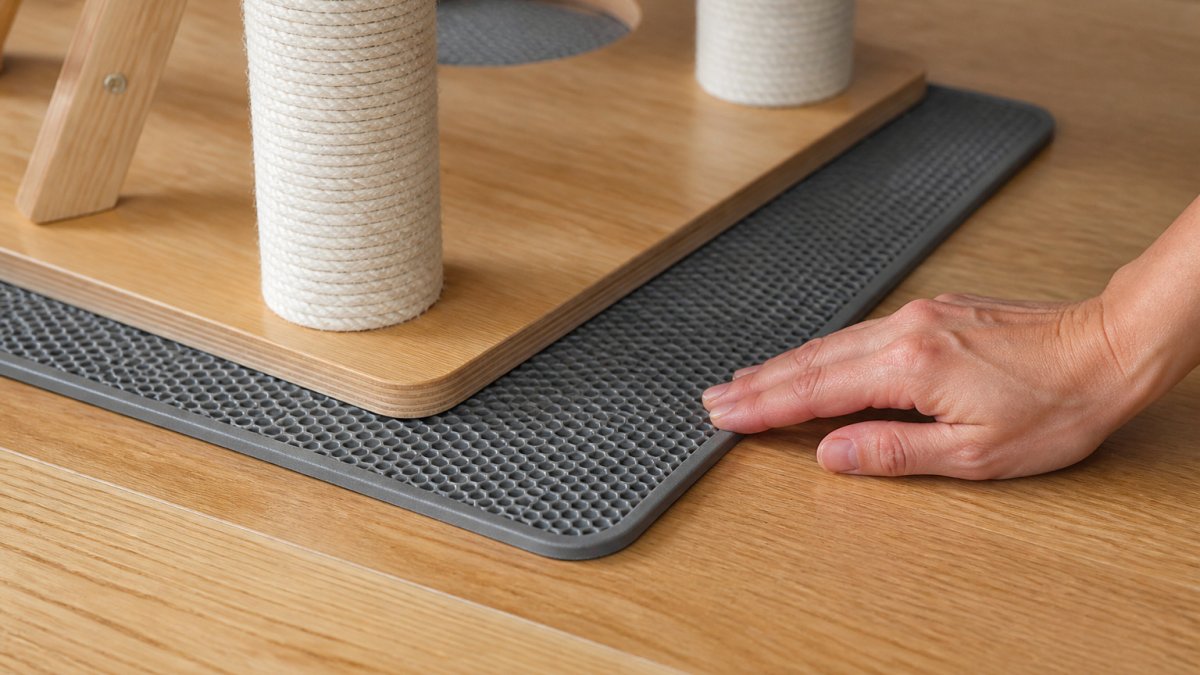
Start by matching the mat to the base footprint. The mat should extend about 2.5 to 5 cm (1 to 2 in) beyond every edge of the base so the tree cannot walk off the mat when a cat lands on the top platform. If you want a floor-level option that holds its position without a tall frame, see the Inclined Wall Floor Cat Scratcher. A mat that is smaller than the base gives the tree a ledge to slide over.
Choose the right backing material
- Natural rubber or nitrile rubber: Look for mats labeled non-marking and suitable for hardwood. Avoid rubber with a strong odor.
- PVC foam or vinyl foam: Common and inexpensive, but some foam backings contain plasticizers that can stain light finishes or leave a ghost outline after months of contact. If you use foam, lift the tree monthly and check the floor.
- Silicone pads or grippy shelf liner: Low-profile and non-staining, good for small bases and low trees. They offer less shock absorption than rubber but are easy to clean and replace.
- Felt: Good for scratch protection but poor for grip on smooth hardwood. Felt alone will not stop a sliding base; use it only under a rubber mat or under furniture feet.
- Carpet or fabric mats: Provide traction but trap grit and hair against the floor, which acts like sandpaper under the base. Avoid loose carpet remnants unless they are backed with rubber and cleaned often.
Avoid these common mistakes
- Curled or thick-edged mats: A curled edge becomes a ramp. Tape the edges down with a hardwood-safe painter's tape during the first week, or choose a mat that lies flat out of the package.
- Adhesive-backed pads: Removable adhesive can leave residue or lift finish on some polyurethane and lacquer surfaces. Test any adhesive in an inconspicuous spot for 24 hours before applying it under a tree.
- Mats over grit: Vacuum and damp-mop the floor before placing the mat. Grit trapped between mat and floor is the main cause of fine scratches under cat trees.
- Newly finished floors: Wait until the finish has fully cured (often several weeks, depending on the product) before placing rubber or foam on it. Check the finish manufacturer's guidance.
A quick friction test
Place the mat on the floor, set the empty tree on it, and push the base sideways with moderate hand pressure. If the base slides more than about 1 cm (0.4 in) before the mat grips, the backing is too smooth or the mat is too small. Try a rubber-backed mat or add weight to the base before moving on to anchoring.
The Lodge Hideout - 2-Level Cat Tree →
Once the mat is in place, retest the tree with a gentle push at the top platform. If the base holds but the frame still sways, move on to Step 4 and Step 5.
The backing you choose matters as much as the grip, so this table compares the common options on hardwood.
| Backing | Best for | Key concern |
|---|---|---|
| Natural or nitrile rubber | Grip and floor safety | Choose non-marking, low odor |
| PVC or vinyl foam | Low cost | Plasticizers can stain light finishes |
| Silicone pad or shelf liner | Small bases, low trees | Less shock absorption |
| Felt | Scratch protection | Poor grip alone |
| Carpet or fabric | Traction | Traps grit, acts like sandpaper |
Step 4: Level the Base and Tighten Every Connection
An uneven base causes rocking even when the floor is grip-friendly. Use a small level on the base plate. If one side is higher, adjust the feet or add a thin shim under the low side.
Then tighten every screw and bolt. Loose joints are a common cause of wobble. Check them every few weeks, especially in the first month after assembly.
Look for these warning signs:
- Posts that twist when you push them
- Platforms that shift sideways
- Screws that have backed out slightly
Step 5: Anchor the Cat Tree to the Wall Safely
For tall trees, wall anchoring adds real stability. Use wall straps or brackets that the manufacturer approves, and attach them to a stud rather than drywall alone. Check the anchor points and hardware before you tighten.
If you rent or prefer not to drill, consider a freestanding tree with a wider base instead. A corner placement also gives the tree support without permanent changes.
Step 6: Protect Your Hardwood Floor From Scratches and Dents
Stability and floor protection are linked: a base that shifts grinds grit into the finish, and a base that sits too long in one spot can leave a mark. Hardwood finishes vary widely, so the safest approach is to reduce pressure, block grit, and inspect regularly.
Understand what actually damages the floor
- Grit and sand: The leading cause of fine scratches under cat trees. A single grain trapped under a sliding base acts like sandpaper. Vacuum and damp-mop before placing any mat or tree.
- Point pressure: A small, hard foot concentrates the tree's weight and a cat's landing force into a tiny area, causing dents in softer woods. Wider feet or a load-spreading mat reduce this.
- Chemical interaction: Some rubber, foam, and vinyl backings contain plasticizers that can migrate into finish and cause discoloration or a sticky residue, especially on light-colored or newly finished floors.
- Moisture: Damp mats or spills trapped under a base can cloud some finishes. Keep the area dry and lift the tree if you notice condensation.
Choose floor-safe materials
- Look for mats and pads labeled non-marking and suitable for hardwood.
- Prefer natural rubber, nitrile rubber, or silicone over unknown foam or PVC backings.
- Use wide, flat furniture feet rather than narrow metal glides under the base.
- Avoid adhesive products on finished wood unless the manufacturer confirms they are removable without residue.
Set up a simple inspection routine
- Monthly: Lift or slide the tree aside, vacuum and damp-mop the floor, and check for scratches, dents, or a ghost outline.
- Seasonally: Rotate the mat or replace worn pads, and retest stability after any move or adjustment.
- After moving the tree: Clean the floor and the base before resetting, and recheck the friction test from Step 3.
Match the fix to your floor and room
- Uneven floors: Use shims under the low side of the base before adding a mat, so the mat is not compensating for a rock.
- Rugs over hardwood: A rug can add grip, but it can also slide. Use a thin, non-marking rug pad and check that the cat tree base does not sit on a rug edge.
- Renters: Choose reversible options, non-marking mats, wide feet, and corner placement, before considering any wall anchor.
- Multi-cat homes: Expect more landing force. Use a larger mat, check fasteners more often, and consider a lower or wider tree.
A stable tree on a protected floor is easier to maintain than a repair. Once the base is gripped and the floor is protected, retest the tree with a gentle push at the top platform and tighten any fasteners that have loosened.
Booking Your Next Cat Tree Upgrade at Bentley's Bark
If your current tree keeps wobbling no matter what you try, it may be time for a sturdier model. The Lodge Hideout 2-Level Cat Tree is priced at $199.99 CAD, and the Hut Hideout 2-Level Deluxe Cat Tree is priced at $299.99 CAD. Both are made in Canada.
Want a stable, floor-friendly option for your home?
Frequently Asked Questions
How do you stabilize a wobbly cat tree?
Start by checking whether the base sits flat. Adjust the feet or add a thin shim under any short corner, then tighten every bolt and screw. Next, place a non-slip mat under the base and move the tree away from doorways and high-traffic spots. If it still rocks when your cat jumps, anchor the top of the tree to a wall stud. Retest after each change, pressing on the upper platform to confirm it no longer moves.
What can you put under a cat tree to stop it from sliding on hardwood?
A rubber-backed non-slip mat or a thick felt pad cut to the size of the base works well on hardwood. Choose a material that grips the floor without leaving residue, and check that it does not stain the finish. Place the mat fully under the base, not just at the corners, so the weight is spread evenly. Replace the mat if it flattens or curls over time, since a compressed pad loses its grip.
Can you secure a cat tree to a wall without damaging hardwood floors?
Yes. Wall anchoring avoids the floor entirely, so it does not scratch or dent hardwood. Use the wall straps or brackets that come with the tree, screwed into a wall stud where possible. Mount the anchor near the top of the tree so it resists tipping when your cat jumps. Avoid drilling into drywall without proper anchors, and check that the strap is taut before your cat climbs.