 ultimate-guide
Why Dogs Need Puzzle Toys for Boredom
Table of Contents
- The Real Cost of Boredom: Why Dogs Need More Than Exercise
- Signs of a Bored Dog You Shouldn't Ignore
- Mental Stimulation for Dogs: The Missing Piece
- How Puzzle Toys Prevent Destructive Behavior and Anxiety
- Types of Puzzle Toys and What They Solve
- How Long Should a Dog Play With a Puzzle Toy
- DIY vs. Store-Bought Puzzle Toys: What Actually Works
- Integrating Puzzle Toys Into Your Dog's Daily Routine
- Frequently Asked Questions
Last Updated: September 20, 2026
The Real Cost of Boredom: Why Dogs Need More Than Exercise
A bored dog isn't just restless, they're at risk. Puzzle toys for boredom are as critical as physical exercise, yet most pet parents focus exclusively on walks and playtime. The difference between a mentally engaged dog and one suffering from chronic boredom shows up in destructive behavior, anxiety, and accelerated cognitive decline as they age.
Why do dogs need puzzle toys for boredom? Because their brains are wired to problem-solve. In the wild, dogs spend hours foraging and hunting. A typical household routine, walk, eat, sleep, repeat, leaves their cognitive systems severely understimulated. Boredom-induced stress triggers the same neurological pathways as separation anxiety, leading to destructive behavior, excessive barking, and escalating behavioral problems.
Puzzle toys bridge this gap by tapping into natural instincts. They transform mealtime into a problem-solving mission and provide the mental challenge their brains crave. Pet parents who introduce puzzle toys report dramatic improvements in dog behavior within the first two weeks: less destructive behavior, calmer demeanor, and better overall engagement.
Signs of a Bored Dog You Shouldn't Ignore
Boredom in dogs manifests in specific, recognizable ways. Many pet parents misinterpret these signs as behavioral problems rather than what they actually are: symptoms of insufficient mental engagement.
Destructive behavior is the clearest indicator. A bored dog targets baseboards, furniture, and shoes with compulsive intensity, especially when alone. Excessive barking, whining, or howling follows a similar pattern: persistent, purposeless, and intensifying in the absence of stimulation.
Restlessness is another signal. A bored dog paces constantly, can't settle during the day, and may sleep poorly at night. Some develop obsessive behaviors like spinning, tail chasing, or repetitive paw licking, stress responses to understimulation.
Lethargy can also indicate boredom. A dog that seems perpetually tired despite adequate sleep may be experiencing learned helplessness, they've given up trying to engage because their environment offers nothing worth engaging with.
Aggression or reactivity toward other dogs or people sometimes stems from boredom as well. A mentally understimulated dog has fewer coping mechanisms and lower frustration tolerance, making them more likely to react defensively in unfamiliar situations.
Mental Stimulation for Dogs: The Missing Piece
Physical exercise and mental stimulation are not interchangeable. A dog that runs for an hour but receives no cognitive challenge still experiences boredom-induced stress. A dog that engages in 20 minutes of focused problem-solving shows measurably calmer behavior than one that's been walked for hours.
Mental engagement activates the prefrontal cortex, responsible for impulse control, decision-making, and emotional regulation (pubmed.ncbi.nlm.nih.gov). A dog solving a puzzle toy strengthens neural pathways that directly reduce anxiety and improve behavioral balance.
Cognitive enrichment satisfies natural instincts exercise alone cannot. Dogs' brains expect to work for food, navigate obstacles, and solve problems. Modern domestication has removed these cognitive demands, creating a mismatch between what their brains evolved to do and what their daily lives offer.
This gap widens with age. Puppies create their own mental stimulation (often destructively), but adult and senior dogs rely on environmental enrichment to maintain cognitive function. Dogs lacking mental stimulation in middle age show steeper cognitive decline as seniors.
A dog that engages regularly with puzzle toys develops better frustration tolerance, improved focus, and more stable emotional responses. They're less likely to develop separation anxiety and more capable of self-regulation.
How Puzzle Toys Prevent Destructive Behavior and Anxiety
Destructive behavior and anxiety are often symptoms of the same underlying problem: insufficient mental engagement. Puzzle toys address both by providing structured cognitive challenge and redirecting natural foraging and problem-solving drives into appropriate outlets.
When a dog works with a puzzle toy, they learn that persistence and problem-solving lead to positive outcomes. This builds confidence and reduces learned helplessness. Repeated problem-solving reshapes how the dog approaches challenges.
A dog experiencing separation anxiety or restlessness often improves when mental stimulation is introduced. The focused attention required to solve a puzzle toy provides a grounding effect, pulling the dog's attention into the present moment and away from anxious thought patterns.
Destructive behavior decreases because the dog's problem-solving drive is now channeled appropriately. Rather than destroying furniture, they get stimulation from the toy. The compulsive quality fades as the underlying cognitive need is met.
Puzzle toys interrupt the anxiety cycle. A dog prone to separation anxiety may spiral into panic when left alone. A challenging puzzle toy provides an alternative focus, giving the dog something to work toward. Many pet parents report their dogs go directly to their puzzle toy when left alone, rather than exhibiting anxiety behaviors.
Interactive Slow Feeder Dog Puzzle Ball →
Types of Puzzle Toys and What They Solve
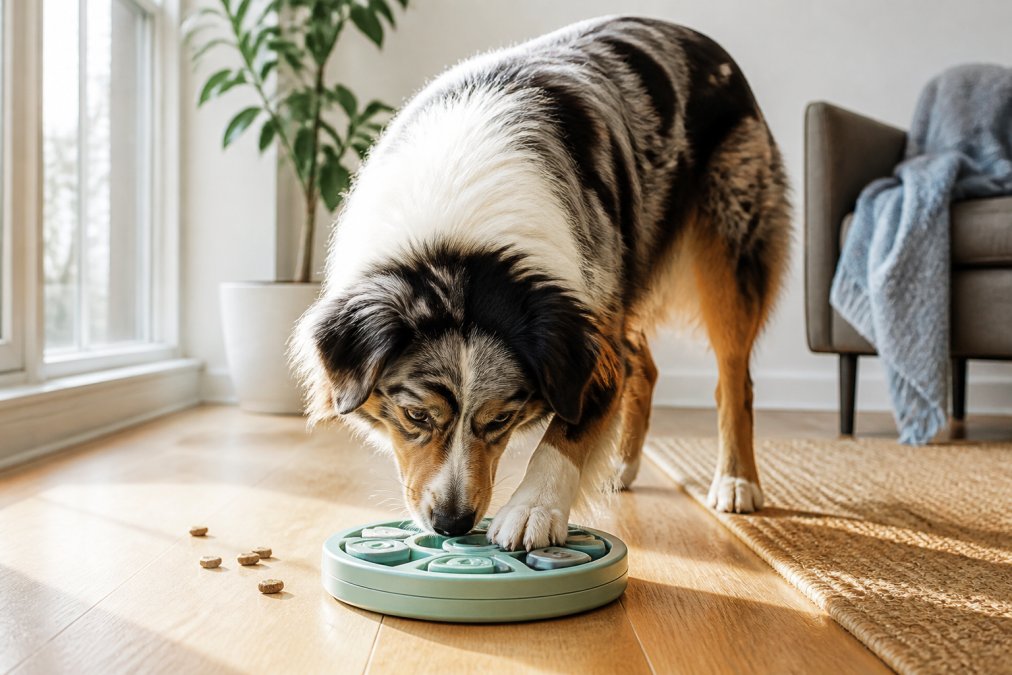
Puzzle toys fall into distinct categories, each solving different enrichment needs. Understanding these types helps you match the right toy to your dog's problem-solving style and skill level.
Treat-Dispensing Toys
Treat-dispensing toys reward problem-solving directly. The dog must manipulate the toy, rolling, nudging, applying pressure, to release treats or kibble. These toys combine mental stimulation with food motivation.
The Interactive Slow Feeder Dog Puzzle Ball from Bentley's Bark exemplifies this category. Made from durable plastic, it dispenses food as dogs nudge and roll it, encouraging problem-solving while slowing eating. This addresses both enrichment and digestive health, preventing bloating and digestive upset.
Treat-dispensing toys work best for food-motivated dogs and fast eaters. They're particularly effective for puppies and high-energy dogs. The limitation is habituation, once dogs figure out the mechanism, novelty fades. Rotating toys or varying treats maintains engagement.
Snuffle Mats and Foraging Toys
Snuffle mats and foraging toys tap into natural scent work and foraging behavior. The dog uses their nose to search and extract hidden treats, engaging their olfactory senses and natural foraging instincts.
Foraging toys solve a different problem than treat-dispensers. They're less about mechanical problem-solving and more about sensory engagement. A dog working a snuffle mat practices sustained focus using their most developed sense, smell. This provides enrichment for dogs not motivated by complex mechanical challenges.
Foraging toys are ideal for senior dogs, anxious dogs, and aggressive chewers. The slower pace and sensory focus provide calming benefits without mechanical components to break apart.
Interactive Slow Feeders
Interactive slow feeders combine the structure of a regular food bowl with puzzle elements. The Pet Puzzle Feeder Toy and Interactive Pet Puzzle Feeder Toy for Dogs and Cats from Bentley's Bark represent this category. These toys turn every meal into a brain game, promoting healthy digestion by slowing down eating while boosting mental stimulation through food-reward play.
Interactive slow feeders solve the problem of fast eating while providing consistent daily enrichment. Since dogs eat multiple times per day, these toys deliver regular cognitive engagement without requiring you to introduce separate enrichment sessions. They're particularly valuable for dogs that bolt their food or show signs of bloating.
The advantage of interactive slow feeders is consistency. Unlike treat-dispensing toys that you use occasionally, slow feeders are part of the daily routine. This provides reliable, predictable mental stimulation that supports behavioral balance and digestive health simultaneously.
How Long Should a Dog Play With a Puzzle Toy
Duration depends on the dog's age, skill level, and toy difficulty. Start with 10-15 minute sessions for puppies and dogs new to puzzle toys. As they develop problem-solving skills, sessions can extend to 20-30 minutes.
Watch for frustration signals.
DIY vs. Store-Bought Puzzle Toys: What Actually Works
Many pet parents attempt DIY puzzle toys to save money using toilet paper tubes, muffin tins, or socks filled with treats. These work briefly but have significant limitations.
Integrating Puzzle Toys Into Your Dog's Daily Routine
Successful enrichment requires systematic integration, not sporadic use. The goal is making mental stimulation as routine as feeding and walking.
Frequently Asked Questions
How often should dogs play with puzzle toys?
Most dogs benefit from 15-30 minutes of puzzle toy engagement daily, though this varies by age, breed, and energy level. High-energy dogs may need multiple sessions throughout the day. Start with shorter periods and observe your dog's frustration tolerance, gradually increasing duration as they improve their problem-solving skills. Rotating different puzzle toys prevents habituation and keeps mental stimulation fresh.
Can puzzle toys help with separation anxiety in dogs?
Yes, puzzle toys are effective tools for managing separation anxiety. By engaging your dog's problem-solving abilities and rewarding focus, they redirect anxious energy into productive behavior. The mental effort required can help tire your dog mentally, promoting calmer behavior when you leave. Introducing puzzle toys during your presence before using them during absences helps build positive associations and confidence.
What makes puzzle toys better than regular toys for boredom?
Puzzle toys engage cognitive enrichment and natural foraging behavior, unlike passive toys. They require problem-solving, encourage reward-based learning, and stimulate your dog's mind rather than just occupying their mouth. This mental engagement directly addresses boredom-induced stress and destructive behavior more effectively than standard toys, creating lasting behavioral improvements and supporting overall canine welfare.
Are puzzle toys suitable for all dog breeds and ages?
Puzzle toys work for most dogs, but difficulty level and design should match your dog's age, size, and chewing strength. Puppies need softer, simpler options; senior dogs may prefer slower-paced toys. High-energy breeds benefit from more challenging designs, while smaller breeds need appropriately sized toys. Always supervise play initially and choose toys from non-toxic materials to ensure safety across all life stages.