 Ultimate guide
7 Hypoallergenic Pet Grooming Mistakes to Avoid
Quick Summary
Hypoallergenic pet grooming products are not regulated, so the label alone cannot guarantee gentleness. Check the ingredient list for milder cleansers, fragrance-free formulas and dye-free options, then patch test any new shampoo on a small area before a full bath.
- No national standard defines 'hypoallergenic' for pet shampoos, so treat the word as a marketing signal.
- Sulfates like SLS can strip natural oils, so milder surfactants are a safer starting point for sensitive skin.
- Choose 'fragrance-free' rather than 'unscented', since unscented products may contain masking fragrance.
- Patch test on the inner leg and watch for 24 hours before bathing your dog fully.
- Persistent itching, hair loss or open sores warrant a veterinarian visit rather than another product switch.
Table of Contents
- What Hypoallergenic Actually Means on a Pet Shampoo Label
- Ingredients to Avoid in Pet Shampoo for Sensitive Skin
- Why Fragrance-Free Pet Shampoo Often Works Better
- Choosing a Dog Shampoo for Sensitive Skin and Itchy Coats
- Telling a True Allergy From Irritation or a Skin Condition
- Building a Complete Grooming Routine Beyond Shampoo
- Your Next Step: Patch Testing and Choosing Your First Gentle Product
- Frequently Asked Questions
What Hypoallergenic Actually Means on a Pet Shampoo Label
Last Updated: October 31, 2026
Hypoallergenic is one of the most common words on pet shampoo bottles, and one of the least regulated. If you're shopping for hypoallergenic pet grooming products at Bentley's Bark or anywhere else, the first thing to know is that no single definition binds the label. There are no national standards defining "hypoallergenic" for pet shampoos, so it's a practical starting point to ask which product is used and what ingredients it contains, not a regulatory guarantee.
So treat the word as a marketing signal, not a promise. It tells you the manufacturer wants you to think about sensitivity, and little more. The label won't say whether it will prevent a reaction in your particular dog.
Here's the mistake we see most often: pet parents assume "hypoallergenic" means "safe for all skin." It doesn't. A product marketed this way can still irritate or trigger an allergic response in an individual animal. A patch test before using any new grooming product is a sensible precaution, because the label can't predict every reaction. You can compare a fragrance-free harness and leash set if you're ready to patch test your dog's next gentle product.
The useful question is what's actually in the bottle. Read the ingredient list, not the front panel. Look for specific exclusions, such as fragrance-free or dye-free formulas, and for named ingredients you recognize. Some gentle shampoos describe themselves as free of sulfates, parabens, phosphates, or synthetic dyes, which gives you something concrete to compare.
Hypoallergenic pet grooming products are worth considering, but read the label as a set of specific claims you can check, rather than a blanket guarantee.
Ingredients to Avoid in Pet Shampoo for Sensitive Skin
If the front label can't promise gentleness, the ingredient list can tell you more, provided you know what you're looking at. The goal isn't to memorize a banned list; it's to understand what each class of ingredient does, which forms are more likely to cause trouble on sensitive skin, and what a gentler alternative looks like on the same label.
Start with the cleansing agents, because they are usually the first ingredients after water and they stay on the skin the longest during a bath. Sulfates such as sodium lauryl sulfate (SLS) and sodium laureth sulfate (SLES) are effective detergents that create lather, but they can strip the natural oils a sensitive coat relies on.
Preservatives are the next thing to scan. Parabens (methylparaben, propylparaben, and similar) are common preservatives, and some pet parents choose to avoid them. They aren't the only option: phenoxyethanol, sodium benzoate, and potassium sorbate are widely used alternatives. The trade-off matters here.
Fragrance is the ingredient most often linked to irritation, and it hides in plain sight. 'Fragrance' or 'parfum' on a label can stand for dozens of undeclared compounds, and essential oils such as tea tree, citrus, peppermint, and eucalyptus are common natural scent sources that can also irritate or, in the case of tea tree, be toxic to cats.
Dyes are the easiest to spot and the easiest to skip. Synthetic colors such as FD&C Blue No. 1 or Yellow No. 5 add appearance with no grooming benefit, and some animals react to them. A clear or naturally colored formula avoids the question entirely.
Beyond those four families, a few other ingredients deserve a second look on sensitive skin. Cocamidopropyl betaine is a mild foam booster that can trigger reactions in a small number of animals. Botanical extracts and proteins (oat, aloe, chamomile, wheat protein) are often added for soothing or conditioning, but any of them can be the specific allergen for an individual pet, which is why a patch test still matters even with a 'natural' formula. pH adjusters and chelating agents such as citric acid and EDTA are generally low-risk and not worth avoiding.
A practical label-reading routine: read the first five ingredients, since they make up most of the formula; check whether the surfactant is a sulfate or a milder family; confirm the preservative system is present and appropriate; and look for 'fragrance-free' and 'dye-free' if your dog has reacted before. Then compare two or three bottles on those specific points rather than on the front-panel claims.
Why Fragrance-Free Pet Shampoo Often Works Better
Fragrance is the single biggest variable to control when your dog has sensitive skin. Scented shampoos can mask odor, but the perfume itself is a common trigger for irritation. For that reason, fragrance-free options are often the safer first choice.
Not every scented product is a poor choice, though. Some deodorizing shampoos use light, naturally derived scents designed to neutralize odor rather than cover it with heavy perfume. If your dog tolerates scent well and you want deodorizing, a lightly scented formula may suit you. If your dog has a history of itching, start with fragrance-free.
The practical rule is simple. Choose fragrance-free when skin sensitivity is the concern, and reserve lightly scented options for dogs with no known reactions.
Choosing a Dog Shampoo for Sensitive Skin and Itchy Coats
When your dog is itchy or has sensitive skin, the right product depends less on the brand than on four variables: coat type, age, the specific skin concern, and how often you bathe. Working through those in order narrows the shelf fast.
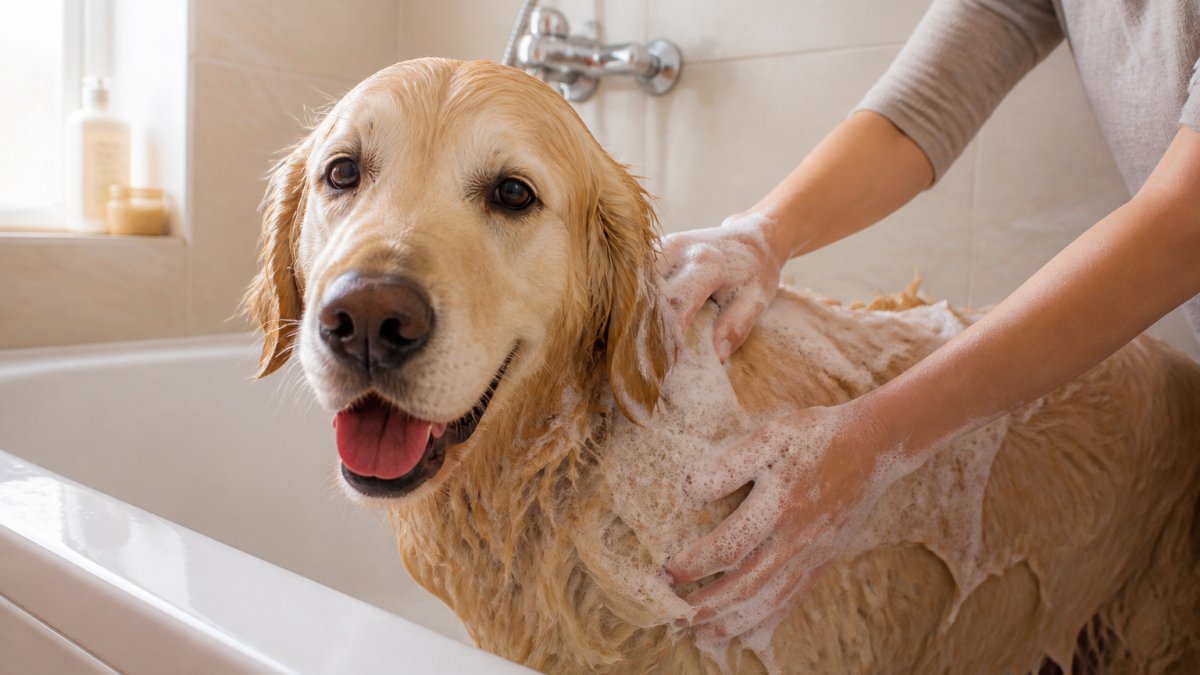
Coat type. Short, smooth coats need little more than a gentle cleansing shampoo and rinse well; heavy conditioner tends to weigh the coat down.
1 Gallon Tearless Puppy Shampoo and Conditioner - Dog Shampoo Itchy Skin Relief →
Age. Puppies have thinner, more permeable skin and are more likely to lick themselves, so a tearless, fragrance-free puppy formula is the sensible default until the coat matures.
Skin concern. For mild itching and flaking, oatmeal-based formulas are the common first choice because oatmeal is used for its soothing qualities. For greasy or yeasty skin, a shampoo with an appropriate active (your vet can advise) may be needed rather than a purely cosmetic gentle formula.
Bathing frequency. Over-bathing dries sensitive skin even with a gentle product. Most dogs do well with a bath every four to eight weeks unless a vet advises otherwise, with spot cleaning or a no-rinse refresh spray in between.
Our pick for sensitive skin is the 1 Gallon Tearless Puppy Shampoo and Conditioner from Bentley's Bark, priced at $84.54 CAD. It's built around oatmeal and coconut oil, has no artificial fragrances, and is designed to be gentle on delicate or sensitive skin.
For a smaller trial, the Cat & Dog Shampoo at $19.95 CAD (100ml) is designed to relieve skin itching and leave the coat soft and tangle-free for regular grooming. It's a low-commitment way to test tolerance before buying a bigger bottle.
Be honest about the limits here. No shampoo can cure an underlying skin condition, and persistent itching warrants a vet visit. Patch test first, and use any shampoo as directed on the label.
The right product depends on a few variables, which this table sets out.
| Factor | Consideration | Starting point |
|---|---|---|
| Coat type | Short, smooth coats | Gentle cleansing shampoo, rinse well |
| Coat type | Double coats | Shampoo that does not strip the undercoat |
| Coat type | Long or curly coats | Detangling conditioner and regular brushing |
| Age | Puppies | Tearless, fragrance-free puppy formula |
| Age | Seniors | Gentle formula, non-slip mat, warm water |
| Skin concern | Mild itching and flaking | Oatmeal-based formulas |
| Skin concern | Odor without perfume | Deodorizing formula, not perfumed |
| Bathing frequency | Most dogs | Every four to eight weeks unless a vet advises otherwise |
Telling a True Allergy From Irritation or a Skin Condition
This is the question most guides skip, and it matters. Redness, itching, or flaking after a bath can come from several sources: an allergy to a specific ingredient, simple irritation from a harsh product, or an unrelated skin condition such as dermatitis or parasites. A new shampoo is only one possible cause.
The pattern helps. Irritation from a product usually appears soon after bathing and fades once the product is rinsed out. A true allergic reaction can be more widespread or escalate. Persistent or worsening symptoms, hair loss, open sores, or a dog that keeps scratching after you've switched products should go to your veterinarian. Only a vet can diagnose the cause.
Keep a simple log: product name, date, and what you observed. It gives your vet something concrete to work with.
Building a Complete Grooming Routine Beyond Shampoo
Shampoo is one piece of a routine that supports skin and coat. Regular brushing and deshedding can help reduce matting between baths. Deshedding your dog regularly is worth building in, especially for heavy-shedding breeds. Our guide explains why deshedding your dog regularly supports skin and coat health. Our guide to why deshedding matters explains the reasoning.
Bathing frequency matters too. Over-bathing can dry sensitive skin even with a gentle product, so bathe only as often as your dog needs. Rinse thoroughly, because leftover residue is a common source of irritation. Finally, a conditioner suited to your dog's coat can help with detangling and softness after the bath.
Dogs and cats have different skin pH and needs, so don't assume a dog product is right for a cat. Check the label for the species it's formulated for.
Your Next Step: Patch Testing and Choosing Your First Gentle Product
Start with a patch test. Apply a small amount of a new shampoo to an inconspicuous area, such as the inner leg, wait 24 hours, and watch for redness, bumps, or itching before using it all over. This is the single most useful habit for avoiding a bad reaction.
Hypoallergenic pet grooming products can help, provided you read the ingredient list, skip fragrances where skin is a concern, and patch test every new bottle. Start small, watch your dog's response, and talk to your vet about anything persistent.
Frequently Asked Questions
What does hypoallergenic mean in pet grooming products?
In pet grooming, hypoallergenic is a marketing term rather than a guarantee. Grooming-service sources note there are no national standards defining hypoallergenic for pet shampoos, so the label does not promise a reaction-free product. Check the ingredient list yourself, look for fragrance-free and dye-free formulas, and remember that a product marketed this way can still irritate an individual animal. Patch testing a small area before a full bath helps you spot problems early.
What ingredients should I avoid in shampoo for pets with sensitive skin?
Many gentle formulas exclude sulfates, parabens, phosphates, phthalates, synthetic dyes and perfumes. Many gentle formulas exclude chemical detergents, phthalates, parabens, sulfates or synthetic dyes. Fragrance is one of the most common irritants, so a fragrance-free or dye-free label is a useful starting point. Ingredients are only one factor, though, and a veterinarian can help identify which specific components affect your pet.
Are fragrance-free pet shampoos better for sensitive skin?
Fragrance-free shampoos remove one common source of irritation, which is why many sensitive-skin formulas are unscented. The Bentley's Bark Cat & Dog Shampoo is positioned for relieving skin itching and leaving the coat soft and tangle-free. Unscented does not automatically mean allergy-free, so introduce any new product gradually, rinse thoroughly, and watch for redness, scratching or flaking over the following days.
Should I consult a veterinarian before changing my pet's grooming products?
Yes, especially if your pet has ongoing itching, redness, hot spots, flaking or a history of skin disease. Persistent symptoms can come from parasites, infections or other conditions that a shampoo will not resolve. A veterinarian can confirm whether a product change is appropriate and rule out an underlying cause before you rely on a new formula to fix the problem.